
MPBF Full Form — What Is Maximum Permissible Bank Finance, Formula, Calculation and Complete Guide 2026
Suresh Agarwal runs a stationery and printing business in Kanpur. Turnover Rs.85 lakh. Clean ITR for 3 years. CIBIL score [ ]
Suresh Agarwal runs a stationery and printing business in Kanpur. Turnover Rs.85 lakh. Clean ITR for 3 years. CIBIL score 718.
He applied for a Cash Credit limit of Rs.18 lakh at his bank. He needed Rs.18 lakh — he had calculated it himself based on his monthly purchases.
The bank sanctioned Rs.11.5 lakh.
Suresh was confused. "Mera business itna bada hai. Rs.18 lakh kyun nahi mila?"
The bank officer explained: "Aapka MPBF Rs.11.5 lakh hai. Hum usse zyada nahi de sakte — regardless of what you requested."
Suresh had never heard the word MPBF before.
He went home, researched for three hours, and came back the next week — this time with a revised balance sheet showing higher inventory and receivables — consistent with his actual business operations he had underreported earlier. His revised MPBF came to Rs.16.8 lakh. The bank sanctioned Rs.16.8 lakh.
The difference was not his business. The difference was understanding one formula.
This guide explains MPBF completely — what it is, exactly how banks calculate it, three methods with worked examples for real Indian businesses, what you can do if your MPBF is too low, and how it connects to your project report.
Quick Answer — MPBF Full Form and Meaning
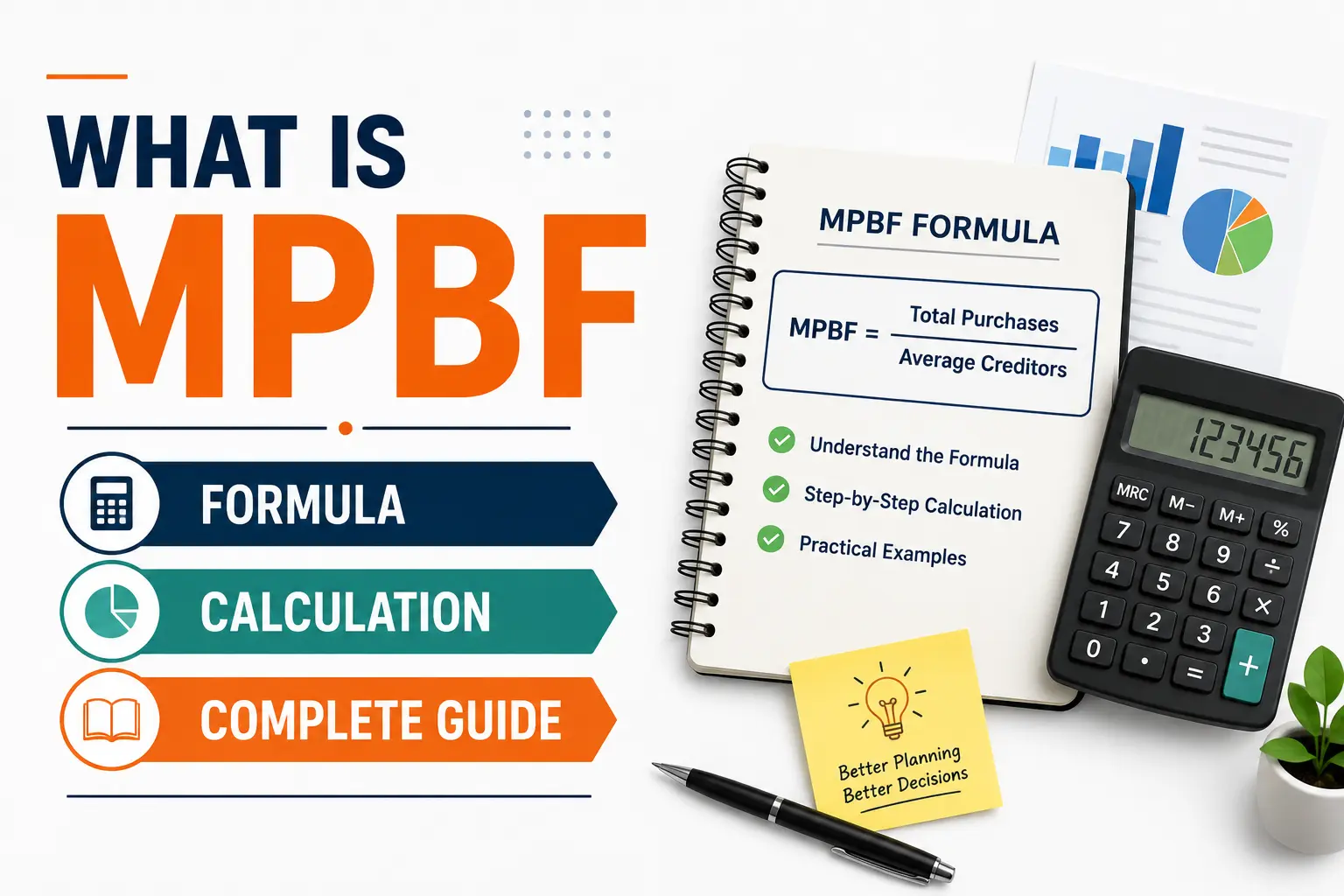
MPBF stands for Maximum Permissible Bank Finance. It refers to the maximum amount of working capital finance that a bank is willing to extend to a borrower, based on the business's financial position, operating cycle, and current assets-liabilities structure. It was introduced by the Tandon Committee in the 1970s following RBI recommendations to standardise working capital assessment across all Indian banks. Banks cannot sanction a working capital Cash Credit or Overdraft limit above the MPBF — regardless of what the borrower requests. Method 2 (Tandon) is the most commonly used: MPBF = 75% of Total Current Assets minus Current Liabilities. Source: rbi.org.in
What You Will Learn in This Guide:
✅ MPBF full form and meaning — plain language explanation
✅ Why banks use MPBF — the Tandon Committee origin
✅ Three MPBF calculation methods — which one your bank uses
✅ Nayak Committee method — for loans below Rs.5 crore
✅ Step by step MPBF calculation with real numbers
✅ MPBF worked examples for 5 business types
✅ What happens when your MPBF is lower than you requested
✅ How to improve your MPBF legally
✅ How MPBF connects to your project report and CMA data
✅ MPBF vs DSCR — what each measures and when each applies
✅ 10 FAQs — every question business owners and CAs ask
Table of Contents
MPBF Full Form — What Does It Mean
MPBF full form is Maximum Permissible Bank Finance.
Every word in this name matters:
Maximum — there is a ceiling. The bank cannot go above it. You cannot negotiate above it. It is a hard limit set by formula.
Permissible — this is the amount the bank is legally and procedurally allowed to sanction. Sanctioning above MPBF violates RBI working capital assessment norms.
Bank Finance — this specifically refers to the bank's contribution to your working capital — the Cash Credit (CC) limit or Overdraft (OD) limit — not a term loan.
The simplest way to understand MPBF:
Your business needs working capital to run — to buy raw materials, maintain inventory, give credit to customers, and cover day-to-day expenses. Some of this comes from your own funds. Some comes from suppliers who give you credit. The rest — the gap — comes from the bank as a CC or OD limit.
MPBF is the formula that determines exactly how much of that gap the bank will fund — and how much you must fund yourself.
MPBF is primarily used to calculate the working capital finance that a business can avail of from a bank. It ensures that companies do not over-borrow beyond their financial capacity and prevents banks from taking unnecessary risks. Direct Credit
MPBF applies to:
✅ Cash Credit (CC) limits
✅ Overdraft (OD) limits
✅ Working Capital Demand Loans (WCDL)
✅ Bills discounting facilities
MPBF does NOT apply to:
❌ Term loans (for machinery, building, vehicles)
❌ Mudra loans (assessed differently)
❌ Personal loans
Why Banks Use MPBF — The Tandon Committee Story
Before the 1970s, Indian banks had no standardised method for assessing working capital requirements. Every bank used its own judgment. This led to serious problems — businesses borrowed far more working capital than they actually needed, funds were diverted to non-business purposes, and banks faced mounting bad loans.
Before MPBF, banks largely followed discretionary lending practices, which often resulted in over-financing, diversion of funds, and inefficient working capital utilization. To address this, MPBF was introduced as a formula-based and structured approach to assess the genuine working capital requirement of a business.
The Reserve Bank of India appointed the Tandon Committee in 1974 to solve this problem. The committee studied working capital requirements across Indian industries and recommended a formula-based approach — the Maximum Permissible Bank Finance.
The core principle: borrowers must fund at least 25% of their current assets from their own long-term resources. The bank funds maximum 75%. This ensures the business owner has genuine skin in the game and cannot use the bank as a substitute for their own capital.
The Tandon Committee suggested three methods for determining MPBF — Method 1, Method 2, and Method 3 — with Method 2 being the most widely adopted, resulting in a minimum current ratio of 1.33. MBA Skool
Today — 50 years later — Tandon Method 2 remains the standard working capital assessment method used by every public sector bank in India.
Three MPBF Calculation Methods
Method 1 — Tandon Method 1 (Less Common)
Formula: MPBF = 75% × (Current Assets − Current Liabilities)
The borrower must contribute 25% of the net working capital gap. Bank funds the remaining 75%.
Example:
| Item | Amount (Rs.) |
|---|---|
| Total Current Assets | 40,00,000 |
| Total Current Liabilities (excluding bank) | 15,00,000 |
| Net Working Capital Gap | 25,00,000 |
| MPBF (75% of gap) | 18,75,000 |
| Borrower's contribution (25%) | 6,25,000 |
Method 2 — Tandon Method 2 (Most Commonly Used)
Formula: MPBF = 75% × Total Current Assets − Current Liabilities
This is stricter than Method 1. The borrower must fund 25% of total current assets — not just the net gap. This results in a minimum current ratio of 1.33.
Example (same numbers):
| Item | Amount (Rs.) |
|---|---|
| Total Current Assets | 40,00,000 |
| 75% of Total Current Assets | 30,00,000 |
| Less: Current Liabilities (excluding bank) | 15,00,000 |
| MPBF | 15,00,000 |
| Borrower's Contribution (25% of CA) | 10,00,000 |
Notice: Method 2 gives Rs.15 lakh vs Method 1's Rs.18.75 lakh — Method 2 is more conservative and more commonly used.
Why Method 2 gives current ratio of 1.33:
After sanctioning MPBF of Rs.15 lakh — total current liabilities become Rs.15L + Rs.15L bank = Rs.30L. Current ratio = Rs.40L ÷ Rs.30L = 1.33. This is the minimum current ratio RBI requires for working capital borrowers.
Method 3 — Tandon Method 3 (Rarely Used)
Formula: MPBF = 75% × (Current Assets − Core Current Assets) − Current Liabilities
This method excludes "core current assets" — the permanent minimum level of inventory and receivables a business always maintains. Very conservative — rarely used in practice. Primarily applicable to very large borrowers with significant permanent working capital tied up.
Which method does your bank use:
Almost all PSU banks — SBI, PNB, Bank of Baroda, Canara Bank, Union Bank — use Tandon Method 2 for loans above Rs.5 crore. For loans below Rs.5 crore — the Nayak Committee method (explained next) is used.
Nayak Committee Method — For Loans Below Rs.5 Crore
For MSME borrowers — which includes most Mudra, PMEGP, CGTMSE, and Stand Up India applicants — the Nayak Committee method is more relevant than Tandon.
Formula: MPBF = 20% of Projected Annual Turnover
That is it. Simple. No current assets calculation needed. No current liabilities analysis. Just 20% of your projected turnover.
Why this matters for MSME borrowers:
RBI mandated that for working capital loans up to Rs.5 crore to MSMEs, banks must use the Nayak Committee method as the minimum — they can give more, but cannot give less than 20% of turnover.
Real example — Suresh's stationery business:
| Item | Amount (Rs.) |
|---|---|
| Projected Annual Turnover | 85,00,000 |
| MPBF (20% of turnover) | 17,00,000 |
Suresh was entitled to Rs.17 lakh under the Nayak Committee method — but his bank used Tandon Method 2 and calculated Rs.11.5 lakh. When Suresh pointed out the Nayak Committee minimum, the bank was obligated to sanction at least Rs.17 lakh. The bank revised to Rs.16.8 lakh (based on his revised CMA) which was above the Nayak minimum.
This is one of the most useful things an MSME owner can know: For working capital loans up to Rs.5 crore, your bank must give you at least 20% of your projected turnover as CC limit — regardless of what the Tandon calculation shows.
Check your MPBF instantly: MudraReady's free MPBF Calculator
Step by Step MPBF Calculation — Real Example
Using Tandon Method 2 — the method your bank actually uses for CMA data.
Business: Medical equipment distributor — Pune
Step 1 — List all current assets:
| Current Asset | Amount (Rs.) |
|---|---|
| Raw material / stock in trade | 12,00,000 |
| Work in progress | 0 |
| Finished goods | 0 |
| Sundry debtors (receivables) | 18,00,000 |
| Advance to suppliers | 2,00,000 |
| Cash and bank balance | 1,50,000 |
| Other current assets | 50,000 |
| Total Current Assets (A) | 34,00,000 |
Step 2 — List all current liabilities (excluding bank borrowing):
| Current Liability | Amount (Rs.) |
|---|---|
| Sundry creditors / payables | 8,00,000 |
| Outstanding expenses | 75,000 |
| Advance from customers | 50,000 |
| Other current liabilities | 25,000 |
| Total Current Liabilities (B) | 9,50,000 |
Step 3 — Apply Tandon Method 2 formula:
| Calculation | Amount (Rs.) |
|---|---|
| 75% of Total Current Assets (0.75 × 34,00,000) | 25,50,000 |
| Less: Total Current Liabilities | 9,50,000 |
| MPBF | 16,00,000 |
| Borrower's own contribution (25% of CA) | 8,50,000 |
The bank can sanction maximum Rs.16 lakh as CC/OD limit.
Step 4 — Verify current ratio:
After sanctioning Rs.16 lakh — total current liabilities = Rs.9.5L + Rs.16L = Rs.25.5L
Current Ratio = Rs.34L ÷ Rs.25.5L = 1.33 ✅ (RBI minimum satisfied)
MPBF for 5 Different Business Types
Business 1 — Kirana Store (Rs.60L annual turnover)
| Item | Amount (Rs.) |
|---|---|
| Stock | 5,00,000 |
| Debtors (30 days) | 2,00,000 |
| Cash | 50,000 |
| Total CA | 7,50,000 |
| Creditors | 3,00,000 |
| Total CL | 3,00,000 |
| MPBF (Method 2) | 2,62,500 |
| Nayak Method (20% of Rs.60L) | 12,00,000 |
Kirana owner should use Nayak Committee method — Rs.12 lakh is significantly higher than Tandon's Rs.2.62 lakh.
Business 2 — Garment Manufacturer (Rs.1.2 crore turnover)
| Item | Amount (Rs.) |
|---|---|
| Raw material (fabric) | 12,00,000 |
| WIP | 3,00,000 |
| Finished goods | 8,00,000 |
| Debtors (45 days) | 15,00,000 |
| Advance to suppliers | 2,00,000 |
| Total CA | 40,00,000 |
| Creditors | 10,00,000 |
| Other CL | 1,50,000 |
| Total CL | 11,50,000 |
| MPBF (Method 2) | 18,50,000 |
| Nayak Method | 24,00,000 |
Garment manufacturer gets Rs.24 lakh under Nayak if loan below Rs.5 crore.
Business 3 — Medical Store (Rs.40L turnover)
| Item | Amount (Rs.) |
|---|---|
| Medicine stock | 4,00,000 |
| Debtors (hospitals — 45 days) | 5,00,000 |
| Cash | 30,000 |
| Total CA | 9,30,000 |
| Creditors | 2,50,000 |
| Total CL | 2,50,000 |
| MPBF (Method 2) | 4,47,500 |
| Nayak Method | 8,00,000 |
Business 4 — Hosiery Unit Ludhiana (Rs.2 crore turnover)
| Item | Amount (Rs.) |
|---|---|
| Yarn (raw material — 45 days) | 18,00,000 |
| WIP | 5,00,000 |
| Finished hosiery | 12,00,000 |
| Debtors (60 days) | 33,00,000 |
| Advance to suppliers | 3,00,000 |
| Total CA | 71,00,000 |
| Creditors | 15,00,000 |
| Other CL | 2,00,000 |
| Total CL | 17,00,000 |
| MPBF (Method 2) | 36,25,000 |
| Nayak Method | 40,00,000 |
Business 5 — Restaurant/Dhaba (Rs.25L turnover)
| Item | Amount (Rs.) |
|---|---|
| Food stock | 1,50,000 |
| Cash and advances | 50,000 |
| Total CA | 2,00,000 |
| Creditors | 75,000 |
| Total CL | 75,000 |
| MPBF (Method 2) | 75,000 |
| Nayak Method | 5,00,000 |
Restaurant should always use Nayak Committee method — Rs.5 lakh vs Rs.75,000 under Tandon.
What Happens When MPBF Is Lower Than You Requested
This is exactly what happened to Suresh. He asked for Rs.18 lakh. His MPBF was Rs.11.5 lakh. Bank sanctioned Rs.11.5 lakh.
Three things you can do:
Option 1 — Accept the lower amount and reapply after 12 months
After operating with the lower CC limit for 12 months — your turnover grows, your debtors grow, your inventory grows. Your MPBF increases. Apply for enhancement. Banks review CC limits annually — you can request enhancement at that point.
Option 2 — Correct underreported current assets
Many business owners underreport stock and debtors in their CMA — either because they track informally or because they declare less in ITR. If your actual business has higher inventory and receivables than what you declared — get them properly documented and refile your CMA. Higher current assets = higher MPBF. This is what Suresh did — he had not included inventory at his warehouse in the original CMA.
Option 3 — Cite the Nayak Committee minimum
For loans below Rs.5 crore — if 20% of your turnover is higher than the Tandon MPBF calculation — point this out to your bank officer. Banks are obligated to use the higher of the two. Get your CA to write a note citing the RBI circular on Nayak Committee norms for MSME working capital.
What you cannot do:
You cannot simply request more than the MPBF and expect the bank to comply. The formula is regulatory — banks cannot exceed it. The only legitimate path is improving your underlying financial position or correctly documenting what already exists.
How to Improve Your MPBF Legally
Strategy 1 — Reduce creditor days (pay suppliers faster)
Paying suppliers faster reduces current liabilities. Lower CL increases MPBF under both Tandon methods. If you can negotiate faster payment terms with one supplier — document it and show reduced payables in your CMA.
Strategy 2 — Extend debtor days (give customers longer credit)
More receivables = higher current assets = higher MPBF. If you currently collect in 30 days — can you extend to 45 days for trusted customers? This legitimately increases your CA and your MPBF. But ensure the extended terms are documented — bank officers verify debtor days against bank credits.
Strategy 3 — Increase inventory holding
Higher inventory = higher CA = higher MPBF. If your business seasonally holds more inventory — show the peak inventory in your CMA projections. Banks assess MPBF based on projected peak levels — not average levels.
Strategy 4 — Improve turnover
Under Nayak Committee method — 20% of turnover. Higher turnover = higher MPBF. If you can project credibly higher turnover with supporting evidence — purchase orders, new contracts, capacity expansion — include it in your CMA projections.
The one thing to never do:
Never fabricate current assets or turnover figures to inflate MPBF. Banks cross-check CMA figures against ITR, GST returns, and bank statements. Inconsistency between these documents is the most common trigger for loan rejection and fraud investigation.
MPBF in Your Project Report and CMA Data
MPBF is Statement 5 in the standard IBA CMA data format — covered in all 7 CMA statements your bank requires for working capital loans.
Where MPBF appears in your documents:
| Document | Where MPBF Appears | What It Shows |
|---|---|---|
| CMA Data | Statement 4 and 5 | Current assets, current liabilities, MPBF calculation |
| Project Report | Financial projections section | Projected MPBF for loan tenure |
| Balance Sheet | Current ratio verification | Confirms 1.33 minimum after sanctioning |
| Loan Application | Working capital requirement | Your requested CC limit vs MPBF |
For Mudra loans (below Rs.10 lakh):
Mudra Shishu and Kishor are assessed informally — Nayak Committee method applies. Your project report should show 20% of turnover as working capital requirement. MudraReady calculates this automatically.
For working capital CC/OD limits above Rs.10 lakh:
Full Tandon Method 2 MPBF calculation is mandatory in Statement 5 of CMA. Your balance sheet must balance. Current ratio must come to exactly 1.33 after the sanctioned amount.
Use MudraReady's free MPBF Calculator
For the complete CMA data guide: What Is CMA Report — Complete Guide 2026
For DSCR calculation: DSCR Complete Guide
MPBF vs DSCR — Key Differences
Most people confuse MPBF and DSCR. They measure completely different things.
| Feature | MPBF | DSCR |
|---|---|---|
| Full Form | Maximum Permissible Bank Finance | Debt Service Coverage Ratio |
| What It Measures | Maximum working capital the bank can lend | Whether the business can repay a specific loan |
| Used For | Cash Credit / OD limit assessment | Term loan and all loan approval |
| Formula | 75% × CA − CL (Tandon) or 20% × Turnover (Nayak) | (Net Profit + Depreciation + Interest) ÷ (Annual EMI + Interest) |
| Minimum Required | No minimum — it is the ceiling | Minimum 1.25 (service) / 1.50 (manufacturing) |
| RBI Guideline | Tandon Committee / Nayak Committee | IBA standard appraisal norms |
| In CMA Data | Statement 4 and 5 | Statement 7 (ratio analysis) |
Simple way to remember:
MPBF answers — "How much can the bank give you?"
DSCR answers — "Can you repay what the bank gives you?"
Both must be satisfied for a working capital loan approval. MPBF sets the ceiling. DSCR confirms repayment capacity within that ceiling.
Frequently Asked Questions
MPBF full form kya hai?
MPBF ka full form hai Maximum Permissible Bank Finance. Yeh woh maximum amount hai jo ek bank kisi business ko working capital ke liye de sakta hai — Cash Credit ya Overdraft limit ke roop mein. Yeh amount ek formula se calculate hoti hai — Tandon Committee Method 2 ya Nayak Committee method — aur bank isse exceed nahi kar sakta. Source: rbi.org.in
What is MPBF in bank loan — simple explanation?
MPBF is the maximum Cash Credit or Overdraft limit a bank can sanction for working capital. When a business applies for a working capital loan, the bank does not simply hand over whatever amount is requested — it follows a structured methodology to determine exactly how much credit it is willing to extend, and that methodology is called Maximum Permissible Bank Finance. The formula ensures you fund at least 25% of your current assets from your own resources — the bank funds maximum 75%. Workingcapitalloan
What is the MPBF formula used by Indian banks?
Two formulas are used. Tandon Method 2 (most common for large loans): MPBF = 75% of Total Current Assets minus Total Current Liabilities (excluding bank borrowing). Nayak Committee method (for MSME loans below Rs.5 crore): MPBF = 20% of Projected Annual Turnover. Banks must use whichever gives a higher amount for MSME borrowers. Calculate your MPBF free here.
Why does MPBF result in current ratio of 1.33?
Under Tandon Method 2 — after the bank sanctions the MPBF — total current liabilities become existing CL plus the new CC limit. The formula is designed so that at maximum MPBF, current assets divided by total current liabilities equals exactly 1.33. This is the minimum current ratio RBI mandates for working capital borrowers — ensuring the business maintains adequate liquidity after taking the CC limit.
Can I get more than the MPBF as working capital loan?
No — banks cannot sanction a CC or OD limit above the MPBF. It is a regulatory ceiling set by RBI through Tandon Committee norms. However, you can improve your MPBF by correctly documenting higher inventory, receivables, or turnover — or by citing the Nayak Committee minimum (20% of turnover) for loans below Rs.5 crore if it gives a higher number than Tandon.
Is MPBF applicable to Mudra loans?
For Mudra Shishu and Kishor (below Rs.5 lakh) — Nayak Committee method applies — 20% of turnover. For Mudra Tarun (Rs.5 lakh to Rs.20 lakh) — Tandon Method 2 is increasingly expected by banks in the CMA data. For working capital CC/OD limits above Rs.10 lakh under any scheme — full Tandon MPBF calculation is mandatory in Statement 5 of CMA data.
What is the difference between MPBF and working capital requirement?
Working capital requirement is your total working capital need — current assets minus current liabilities. MPBF is how much of that requirement the bank will fund — maximum 75% under Tandon Method 2. The remaining 25% must come from your own funds — called the promoter's contribution or net working capital margin. MPBF is always less than or equal to the total working capital requirement.
How does MPBF appear in the CMA report?
MPBF appears in Statement 4 (Comparative Statement of Current Assets and Current Liabilities) and Statement 5 (MPBF Calculation) of the standard IBA CMA data format. Statement 4 lists all current assets and liabilities. Statement 5 applies the Tandon formula and shows the maximum CC/OD limit the bank can sanction. Both statements must show consistent figures — and the resulting current ratio must equal 1.33. Generate CMA with MPBF auto-calculated at MudraReady.
What happens if my MPBF is less than what I need?
Three options. First — accept the lower amount and apply for enhancement after 12 months of operation when your turnover and current assets have grown. Second — correctly document current assets you may have underreported — stock at warehouse, receivables from all customers — and refile CMA. Third — cite Nayak Committee minimum (20% of turnover) for loans below Rs.5 crore if it gives a higher figure. Never fabricate figures — bank cross-checks CMA against ITR and GST returns.
Is MPBF the same as the loan amount I will receive?
No — MPBF is the ceiling. The actual loan sanctioned can be equal to or less than MPBF — never more. The bank may sanction less than MPBF based on credit assessment, DSCR, CIBIL score, or other factors. MPBF sets the upper limit. DSCR, current ratio, and debt-equity ratio determine how close to that limit the bank is willing to go.
Conclusion — The Formula That Decides Your CC Limit
Suresh Agarwal did not get Rs.18 lakh because he asked for Rs.18 lakh. He got Rs.16.8 lakh because that is what his MPBF allowed — after he correctly documented his actual current assets.
The bank was not being arbitrary. The bank was following a formula — the same formula every PSU bank in India has used for 50 years since the Tandon Committee recommended it.
Understanding MPBF takes 20 minutes. Not understanding it can cost you lakhs in underfunded working capital — or worse, a rejected application for a loan your business genuinely needs.
Calculate your MPBF before you walk into any bank:
MudraReady's free MPBF Calculator — instant result, no registration required.
Ready to generate a complete project report with MPBF auto-calculated in IBA format:
MudraReady.in — Rs.399, 10 minutes, first report completely FREE.
Sources: rbi.org.in — Tandon Committee Working Capital Norms | IBA Standard Credit Appraisal Format 2025-26 | msme.gov.in — Nayak Committee MSME Working Capital Guidelines | RBI Circular on Working Capital Finance to MSMEs | Tandon Committee Report 1974
Last Updated: July 2026
RankMath Settings:
Focus Keyword: MPBF full form
Meta Title: MPBF Full Form — What Is Maximum Permissible Bank Finance 2026 | MudraReady
Meta Description: MPBF full form is Maximum Permissible Bank Finance. Formula, 3 calculation methods, 5 business examples, Nayak Committee method, how to improve MPBF. Free calculator MudraReady.
WordPress Instructions:
- Create new post — fresh URL
- Paste H1 title to Sources line
- FAQs — RankMath FAQ block
- Focus Keyword: MPBF full form
- Internal link to MPBF calculator page and CMA guide
- Publish
Ready to Apply for your Business Loan?
Most banks reject loans due to incorrect project reports. Create a professional, bank-compliant project report in just 5 minutes with MudraReady.
