
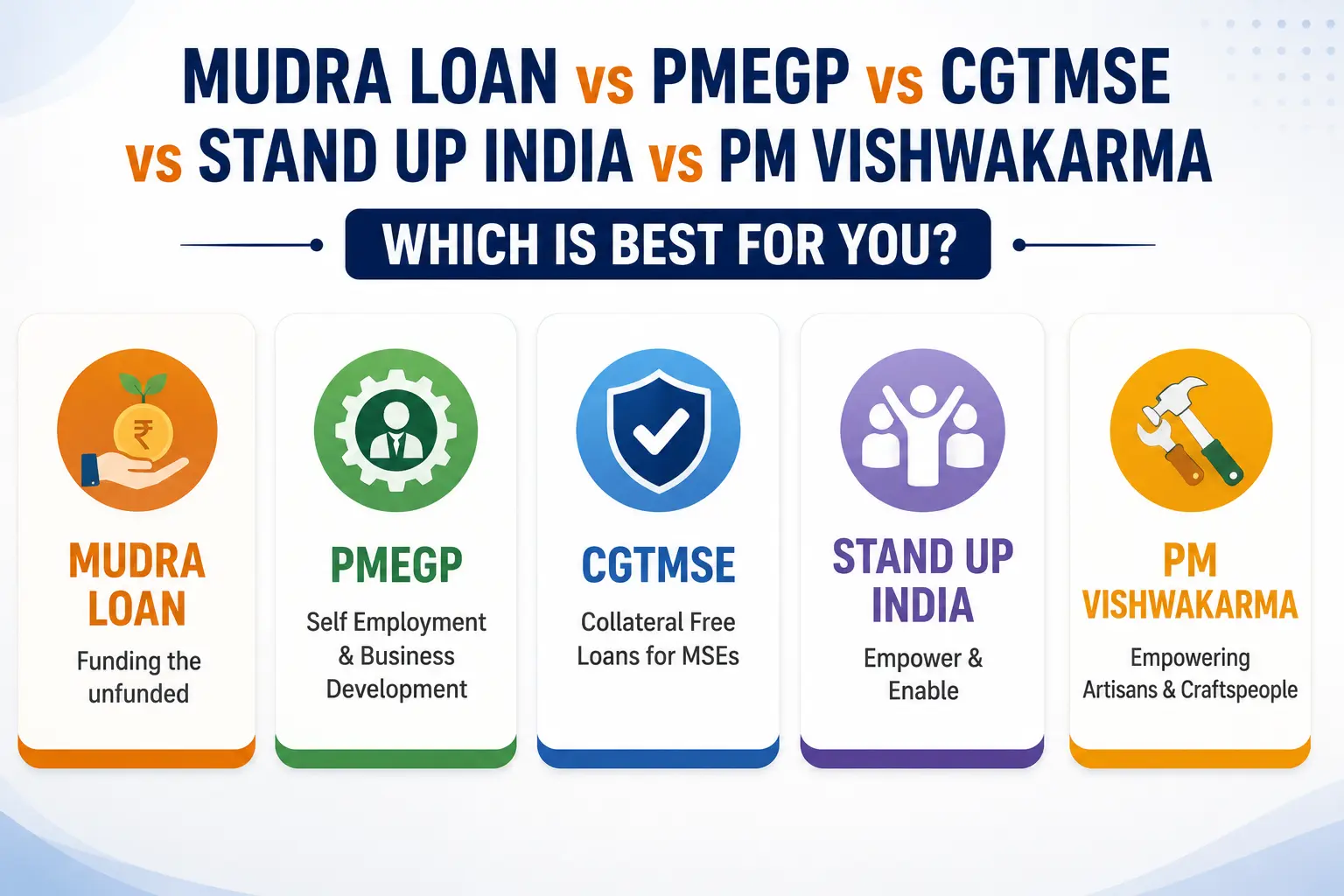
Mudra Loan vs PMEGP vs CGTMSE vs Stand Up India vs PM Vishwakarma — Which Government Scheme Is Right for Your Business in?
Three people walked into three different bank branches on the same day in the same city — Lucknow, Uttar Pradesh. [ ]
Three people walked into three different bank branches on the same day in the same city — Lucknow, Uttar Pradesh.
Ramesh owns a kirana store. Eight years in business. Steady income. Wants Rs.3 lakh to expand his stock and buy a billing computer. He applied for PMEGP.
Anjali wants to start a new agarbatti and spice packaging unit. No business yet. Total project cost Rs.10 lakh. She applied for a Mudra Kishor loan.
Vikram is an SC category entrepreneur. Wants to start a garment manufacturing unit. Rs.25 lakh project cost. He applied for PMEGP.
Six weeks later:
Ramesh's PMEGP application was rejected. Reason — PMEGP is only for new businesses. His existing kirana store did not qualify.
Anjali's Mudra application was processed — but she received only Rs.2 lakh working capital, not Rs.10 lakh for her full project. Mudra Kishor goes up to Rs.5 lakh, and without a strong project report showing manufacturing viability, the bank approved only partial funding.
Vikram's PMEGP application was approved — but he received only 15% subsidy. He had not declared his SC category correctly. He should have received 35%.
Three avoidable mistakes. Three wasted months.
Ramesh should have applied for Mudra Kishor — existing businesses are eligible. Anjali should have applied for PMEGP — new manufacturing business with subsidy was exactly her situation. Vikram applied for the right scheme but got the wrong subsidy because he did not know about the SC/ST special category benefit.
This guide exists so you do not make any of these mistakes. By the end, you will know exactly which government loan scheme fits your specific situation — and what to do next.
What You Will Learn in This Guide:
✅ The 5 questions that determine your scheme — answer them and get your answer
✅ Master comparison table — all 6 schemes across 15 features in one place
✅ Mudra, PMEGP, CGTMSE, Stand Up India, PM Vishwakarma, NABARD — each explained clearly
✅ 6 real business scenarios — which scheme fits each one and why
✅ Scheme combination strategies — when using two schemes together makes sense
✅ What to do next — scheme to action in 5 steps
✅ Documents needed for each scheme — side by side
✅ 10 FAQs — every question first-time applicants ask
Table of Contents
Why Choosing the Wrong Scheme Costs You Months
Every government loan scheme in India has a specific purpose, a specific audience, and a specific set of rules. Mudra is not interchangeable with PMEGP. CGTMSE is not a loan — it is a guarantee. Stand Up India is not for everyone — only SC/ST and women. PM Vishwakarma is only for 18 traditional trades.
Applying for the wrong scheme does not just get your application rejected. It costs you:
Time: PMEGP takes 2-4 months to process. If you apply for PMEGP and get rejected after 3 months because your business is existing — you have lost 3 months. Apply for Mudra, get approved in 2 weeks.
Money: Vikram applied for PMEGP under the general category. He received 15% subsidy — Rs.1.5 lakh on a Rs.10 lakh project. If he had correctly declared his SC category, he would have received 35% — Rs.3.5 lakh. That is Rs.2 lakh he never got back.
Credibility: A rejected application — especially for PMEGP where KVIC and the bank both review your file — creates a record. While it does not legally prevent reapplication, it can make future applications at the same bank more scrutinised.
According to SIDBI's MSME Pulse Report, wrong scheme selection is among the top 5 reasons for first-time loan application failure in India's MSME sector. The information problem is real — and solvable.
The 5 Questions That Determine Your Scheme
Answer these five questions honestly. Your answers will point directly to your scheme.
Question 1: Is your business new or existing?
New — you are starting from scratch, have not yet begun operations, have no Udyam registration for this business → PMEGP, Stand Up India, PM Vishwakarma, Mudra (all eligible for new)
Existing — you already run this business, even informally → Mudra, CGTMSE (PMEGP and Stand Up India do not cover existing businesses)
Question 2: How much money do you need?
Up to Rs.50,000 → Mudra Shishu
Rs.50,000 to Rs.5 lakh → Mudra Kishor
Rs.5 lakh to Rs.20 lakh → Mudra Tarun or PMEGP (if new manufacturing)
Rs.10 lakh to Rs.1 crore → Stand Up India (if SC/ST or women) or CGTMSE
Above Rs.1 crore → CGTMSE (up to Rs.10 crore)
Question 3: Do you want a government subsidy?
Yes — and willing to wait 2-4 months → PMEGP (25-35% subsidy)
Yes — artisan in one of 18 trades → PM Vishwakarma (Rs.15,000 toolkit + 5% interest)
No — want money fast → Mudra or CGTMSE
Question 4: Are you SC/ST or a woman?
Yes — and starting a new enterprise above Rs.10 lakh → Stand Up India first
Yes — and starting a new manufacturing unit → PMEGP (special category 35% subsidy)
Yes — and traditional artisan → PM Vishwakarma
No → Mudra, PMEGP (general category), CGTMSE
Question 5: Do you have property to pledge as collateral?
Yes → Any scheme — collateral helps with larger loans
No → All government schemes covered here are collateral-free or CGTMSE-guaranteed
If you have no collateral and need above Rs.10 lakh → CGTMSE is specifically designed for this
Quick Decision Table — Your Situation to Your Scheme in 2 Minutes
| Your Situation | Best Scheme | Why |
| Existing kirana/salon/tailoring — need Rs.50K to Rs.5L fast | Mudra Kishor | Fastest approval, existing businesses eligible |
| Existing business — need Rs.5L to Rs.20L | Mudra Tarun | Same as above — higher amount |
| New manufacturing unit — want government subsidy | PMEGP | 25-35% of project cost never repaid |
| New business — need Rs.5L to Rs.10 crore — no collateral | CGTMSE | Government guarantee replaces collateral |
| SC/ST or woman — new enterprise — Rs.10L to Rs.1Cr | Stand Up India | Reserved quota per branch — highest priority |
| Traditional artisan in 18 trades | PM Vishwakarma | 5% loan + toolkit + training — unique bundle |
| Dairy farm, poultry, agro-processing | NABARD | Sector-specific subsidy and refinance |
| New business AND SC/ST or woman | Stand Up India + PMEGP combined | Maximum benefit for eligible category |
| Need more than Rs.3L after PM Vishwakarma | Mudra Kishor or Tarun next | Sequence: PM Vishwakarma first, then Mudra |
| Existing MSME — need working capital above Rs.5Cr | CMA data route through bank | CGTMSE + CMA format project report |
Mudra Loan — Who It Is For and When to Choose It
What it is: Pradhan Mantri Mudra Yojana (PMMY) provides collateral-free loans to micro and small businesses through banks, NBFCs, and MFIs. Launched 2015. Administered by MUDRA (Micro Units Development and Refinance Agency).
Choose Mudra when:
- You have an existing business and need working capital or small expansion funding
- You need money quickly — Mudra loans process in 1-3 weeks
- Your loan requirement is between Rs.50,000 and Rs.20 lakh
- You run any type of business — trading, service, or manufacturing
Mudra loan tiers — 2026:
| Category | Loan Amount | For | EMI Example |
| Shishu | Up to Rs.50,000 | Micro businesses in earliest stage | Rs.50K at 11% over 3 years = Rs.1,635/month |
| Kishor | Rs.50,001 to Rs.5 lakh | Established small businesses | Rs.3L at 11% over 5 years = Rs.6,536/month |
| Tarun | Rs.5 lakh to Rs.10 lakh | Growing businesses | Rs.8L at 11% over 5 years = Rs.17,430/month |
| Tarun Plus | Rs.10 lakh to Rs.20 lakh | Businesses ready to scale | Rs.15L at 11% over 7 years = Rs.25,480/month |
Ramesh's correct choice — Mudra Kishor:
Ramesh's kirana store needed Rs.3 lakh for stock expansion and a billing computer. He is an existing business — 8 years old. Mudra Kishor was exactly right. He applied, submitted his project report generated at MudraReady.in, and received Rs.3 lakh in 17 working days.
His original PMEGP application would have been rejected immediately — PMEGP does not fund existing businesses.
When Mudra is NOT the right choice:
❌ You want a government subsidy — Mudra has no subsidy component
❌ You need more than Rs.20 lakh — CGTMSE is better
❌ You are a traditional artisan — PM Vishwakarma gives you a concessional 5% rate vs Mudra's 11%+
❌ You are SC/ST or a woman starting a new Rs.10L+ enterprise — Stand Up India gives you a reserved quota
For complete Mudra loan details: Mudra Loan Complete Guide
Use MudraReady's free EMI Calculator to calculate your exact Mudra EMI.
PMEGP — Who It Is For and When to Choose It
What it is: Prime Minister's Employment Generation Programme — a credit-linked subsidy scheme for new enterprises in manufacturing and service sectors. Administered by KVIC (Khadi and Village Industries Commission). Launched 2008.
Choose PMEGP when:
- You are starting a NEW business — PMEGP strictly does not cover existing businesses
- Your business is in manufacturing or processing — or eligible service sectors
- You want a non-repayable government subsidy reducing your effective loan burden
- You are willing to wait 2-4 months for the process to complete
PMEGP subsidy — real rupee calculations:
| Category | Location | Project Cost | Subsidy % | Subsidy Amount | You Repay |
| General | Urban | Rs.10 lakh | 15% | Rs.1,50,000 | Rs.7,50,000 (75% loan) |
| General | Rural | Rs.10 lakh | 25% | Rs.2,50,000 | Rs.6,50,000 |
| SC/ST/Women | Urban | Rs.10 lakh | 25% | Rs.2,50,000 | Rs.6,50,000 |
| SC/ST/Women | Rural | Rs.10 lakh | 35% | Rs.3,50,000 | Rs.5,50,000 |
| SC/ST/Women | Rural | Rs.50 lakh | 35% | Rs.17,50,000 | Rs.30,00,000 |
Anjali's correct choice — PMEGP:
Anjali's agarbatti and spice packaging unit was a new manufacturing business. Rs.10 lakh project cost. She is SC category in an urban location — 25% subsidy = Rs.2.5 lakh she would never repay.
Her original Mudra application gave her only Rs.2 lakh working capital — not the full Rs.10 lakh project funding she needed. PMEGP was the right scheme because it funds the entire new manufacturing project, not just working capital.
Vikram's mistake — and the Rs.2 lakh it cost him:
Vikram is SC category. He applied for PMEGP correctly. But he filled his application as "General" category. He received 15% subsidy — Rs.1.5 lakh on Rs.10 lakh. Correct category would have been SC — 35% rural = Rs.3.5 lakh subsidy. A Rs.2 lakh error caused by not reading the category correctly on the application form.
When PMEGP is NOT the right choice:
❌ Your business is already running — PMEGP is strictly for new enterprises
❌ You run a hotel, restaurant, or dhaba — food service is on the negative list
❌ You need the money within 2-4 weeks — PMEGP takes 2-4 months minimum
❌ Your business involves trading — general trading is not eligible
For complete PMEGP details: PMEGP Loan Complete Guide 2026
CGTMSE — Who It Is For and When to Choose It
What it is: Credit Guarantee Fund Trust for Micro and Small Enterprises — a government guarantee scheme that enables banks to give collateral-free loans to MSMEs. CGTMSE does not lend directly — it provides guarantee to the bank. Administered by CGTMSE Trust under Ministry of MSME and SIDBI.
The most important thing to understand about CGTMSE:
CGTMSE is not a standalone loan scheme you apply to directly. It is a guarantee framework that sits behind a regular bank loan. When you apply for an MSME loan at SBI, PNB, or any bank — you or your banker can request that the loan be covered under CGTMSE. This removes the collateral requirement because the government guarantees 75-85% of the bank's risk.
Choose CGTMSE when:
- You need above Rs.5 lakh and have no property to pledge as collateral
- Your loan amount is between Rs.2 lakh and Rs.10 crore
- You are an existing or new business in manufacturing or service
- You want to avoid pledging your home, land, or other assets
CGTMSE guarantee coverage — 2026 (post April 2025 revision):
| Business Category | Maximum Loan | Guarantee Cover |
| Micro Enterprise | Rs.10 crore | 85% |
| Small Enterprise | Rs.10 crore | 75% |
| Women Entrepreneur | Rs.10 crore | 85% |
| SC/ST Entrepreneur | Rs.10 crore | 85% |
| DPIIT Startup (CGSS) | Rs.20 crore | 85% |
Annual Guarantee Fee — what it costs:
| Loan Amount | Annual Fee |
| Up to Rs.10 lakh | 0.37% per annum |
| Rs.10L to Rs.50L | 0.55% per annum |
| Rs.50L to Rs.1 crore | 0.60% per annum |
| Rs.1Cr to Rs.5 crore | 1.00% per annum |
| Rs.5Cr to Rs.10 crore | 1.20% per annum |
On a Rs.12 lakh loan — annual fee = 0.55% = Rs.6,600 per year. This is recovered by the bank through slightly higher interest rate — typically 1% to 1.5% above a standard secured loan.
When CGTMSE is NOT the right choice:
❌ Your loan is below Rs.2 lakh — Mudra Shishu is simpler
❌ You want a direct subsidy — CGTMSE has no subsidy component
❌ You are a traditional artisan — PM Vishwakarma's 5% rate beats CGTMSE economics
For complete CGTMSE details: CGTMSE Loan Complete Guide 2026
Use MudraReady's free CGTMSE Calculator to calculate your guarantee fee.
Stand Up India — Who It Is For and When to Choose It
What it is: A government initiative mandating all scheduled commercial banks to provide loans of Rs.10 lakh to Rs.1 crore to at least one SC/ST borrower and at least one woman borrower per branch — for setting up greenfield enterprises. Monitored by SIDBI through standupmitra.in.
Choose Stand Up India when:
- You are SC, ST, or a woman entrepreneur
- You are starting a NEW (greenfield) enterprise — your first business
- You need between Rs.10 lakh and Rs.1 crore
- You have no collateral — CGTMSE covers it automatically
The mandate advantage:
Every bank branch must fill a Stand Up India quota. Your application is not competing with thousands of others — it is filling a reserved slot. This is the single most powerful structural advantage of any government loan scheme in India.
Stand Up India Loan structure:
| Component | Details |
| Loan Amount | Rs.10 lakh to Rs.1 crore |
| Type | Composite — term loan + working capital |
| Bank Funds | 75% of project cost |
| Own Contribution | 25% (can include PMEGP subsidy) |
| Interest Rate | MCLR + 3% + tenor premium (~12-12.5%) |
| Moratorium | Up to 18 months |
| Repayment | Up to 7 years |
When Stand Up India is NOT the right choice:
❌ You are a general category male entrepreneur — not eligible
❌ Your business is already running — Stand Up India is greenfield only
❌ Your project cost is below Rs.13.33 lakh — minimum loan Rs.10 lakh not achievable
❌ You need more than Rs.1 crore — CGTMSE goes up to Rs.10 crore
For complete Stand Up India details: Stand Up India Complete Guide 2026
PM Vishwakarma — Who It Is For and When to Choose It
What it is: A central government scheme exclusively for traditional artisans in 18 designated trades — providing formal recognition, free skill training with Rs.500/day stipend, Rs.15,000 toolkit grant, and collateral-free loans up to Rs.3 lakh at a concessional 5% interest rate. Administered by Ministry of MSME through pmvishwakarma.gov.in.
Choose PM Vishwakarma when:
- You practice one of the 18 traditional trades — carpenter, blacksmith, tailor, goldsmith, potter, cobbler, barber, mason, and others
- You want the lowest possible interest rate — 5% vs 11%+ for Mudra
- You want free tools worth Rs.15,000 alongside your loan
- You have not taken a Mudra loan for the same trade in the last 5 years
The 5% interest advantage — real savings:
| Loan | Mudra at 11% (18 months) | PM Vishwakarma at 5% (18 months) | Savings |
| Rs.1 lakh | Total interest: Rs.9,720 | Total interest: Rs.7,208 | Rs.2,512 |
On a small loan the saving seems modest — but for an artisan earning Rs.10,000-15,000 per month, saving Rs.2,500 in interest is meaningful. More importantly, the Rs.15,000 toolkit grant effectively means you receive Rs.1,15,000 in total value for a Rs.1 lakh loan application.
When PM Vishwakarma is NOT the right choice:
❌ Your trade is not on the 18-trade list
❌ You took a Mudra loan for this trade in the last 5 years
❌ You need more than Rs.3 lakh — combine with Mudra after repaying both tranches
❌ You run a manufacturing unit with multiple employees — you are beyond individual artisan stage
For complete PM Vishwakarma details: PM Vishwakarma Yojana Complete Guide 2026
NABARD — Who It Is For and When to Choose It
What it is: National Bank for Agriculture and Rural Development provides refinance to banks for agricultural and rural development lending — including dairy, poultry, fisheries, agro-processing, and rural infrastructure. Loans are disbursed through cooperative banks, regional rural banks, and commercial banks — not directly by NABARD.
Choose NABARD when:
- Your business is dairy farming, poultry farming, fisheries, or agro-processing
- You are in a rural area or semi-urban area
- You want capital subsidy — NABARD's Dairy Infrastructure Development Fund offers 25-33% subsidy
- You need financing for agricultural allied activities
NABARD key schemes:
| Scheme | Purpose | Subsidy |
| DEDS (Dairy Entrepreneurship Development Scheme) | Dairy farm setup, milk processing | 25% general, 33.33% SC/ST/women |
| Poultry Venture Capital Fund | Broiler, layer, hatchery | 25% of project cost |
| Fisheries | Fish farming, cold storage | 40% for small units |
| KCC (Kisan Credit Card) | Crop loans, animal husbandry | Subsidised interest |
When NABARD is NOT the right choice:
❌ Your business is non-agricultural — retail, service, manufacturing outside agri-processing
❌ You are in an urban area — NABARD focus is rural and semi-urban
❌ You need quick disbursement — NABARD-linked loans take 6-12 weeks
For NABARD dairy and poultry details: NABARD Loan Complete Guide
Master Comparison — All 6 Schemes Across 15 Features
| Feature | Mudra | PMEGP | CGTMSE | Stand Up India | PM Vishwakarma | NABARD |
| Maximum Loan | Rs.20 lakh | Rs.50 lakh (mfg) | Rs.10 crore | Rs.1 crore | Rs.3 lakh | Varies |
| Minimum Loan | Rs.10,000 | Rs.5 lakh | Rs.2 lakh | Rs.10 lakh | Rs.1 lakh | Rs.1 lakh |
| Interest Rate | 8-12% | Market rate | Market rate + 1% | MCLR + 3% | 5% (subsidised) | Subsidised |
| Government Subsidy | None | 25-35% | None | None | 8% interest subvention + Rs.15K toolkit | 25-40% capital |
| Collateral | None | None up to Rs.10L | CGTMSE guarantee | CGTMSE guarantee | None | Varies |
| New Business | Yes | Yes — only | Yes | Yes — only | Yes | Yes |
| Existing Business | Yes | No | Yes | No | Yes | Yes |
| Who Can Apply | Anyone | Anyone | Any MSME | SC/ST/women only | 18 trades only | Agri-allied only |
| Processing Time | 1-3 weeks | 2-4 months | 3-6 weeks | 6-16 weeks | 4-8 weeks | 6-12 weeks |
| Project Report | Yes — mandatory | Yes — mandatory | Yes — mandatory | Yes — mandatory | Simplified | Yes — mandatory |
| Udyam Registration | Yes | Yes | Yes | Yes | CSC registration | Yes |
| SC/ST Extra Benefit | Priority | 35% subsidy | 85% guarantee | Reserved quota | Same as all | Higher subsidy |
| Women Extra Benefit | Priority | 35% subsidy | 85% guarantee | Reserved quota | Same as all | Higher subsidy |
| Trading Businesses | Yes | No | Yes | Yes | No | No |
| Hotels/Restaurants | Yes | No | Yes | Yes | No | No |
Real Scenarios — 6 Business Types, 6 Scheme Decisions
Scenario 1 — Kirana Store Owner, Existing Business, Rs.3 Lakh
Who: Ramesh, Lucknow, 8-year-old kirana store, wants to expand stock and buy billing computer
Right scheme: Mudra Kishor
Why: Existing business — PMEGP not eligible. Amount under Rs.5 lakh — Mudra Kishor exact fit. Processing time 1-3 weeks — money available fast. No collateral needed.
Wrong choice he made: PMEGP — wasted 3 months before rejection.
What he should do: Apply for Mudra Kishor at nearest SBI or PNB branch. Generate project report at MudraReady. Submit. Done.
Scenario 2 — New Agarbatti Manufacturing Unit, Rs.10 Lakh
Who: Anjali, SC category, urban Bhopal, starting new agarbatti and spice packaging
Right scheme: PMEGP — SC urban category = 25% subsidy = Rs.2.5 lakh non-repayable
Why: New manufacturing business — PMEGP perfect fit. SC category — 25% subsidy vs 15% for general. Willing to wait 2-4 months for the subsidy benefit.
What she should do: Apply at kviconline.gov.in/pmegpeportal. Complete EDP training in parallel. Generate PMEGP project report at MudraReady.
Scenario 3 — Iron Fabrication Workshop, Rs.12 Lakh, No Collateral
Who: Suresh, Varanasi, existing iron fabrication business, needs machinery upgrade, owns no property
Right scheme: CGTMSE
Why: Existing business — PMEGP and Stand Up India not eligible. Needs Rs.12 lakh — above Mudra Tarun Plus limit? No — Mudra Tarun Plus goes to Rs.20 lakh but for Rs.12 lakh CGTMSE gives cleaner collateral-free structure for larger amounts. Has no property — CGTMSE replaces collateral with government guarantee.
What he should do: Apply at SBI or Bank of Baroda. Request loan under CGTMSE explicitly. Generate CGTMSE project report. Check DSCR first: DSCR Calculator.
Scenario 4 — SC Category Woman Starting Garment Unit, Rs.25 Lakh
Who: Lakshmi, SC category, Tamil Nadu, starting new garment manufacturing unit, Rs.25 lakh project
Right scheme: Stand Up India — AND consider combining with PMEGP
Why: SC category + woman + new enterprise + Rs.10L to Rs.1Cr = classic Stand Up India. Reserved quota per branch — she gets priority processing. CGTMSE guarantee covers collateral. Additionally, as a new manufacturing unit, she could apply for PMEGP subsidy (35% rural SC/ST women) and fund the balance through Stand Up India.
What she should do: Apply at standupmitra.in as Ready Borrower. Generate Stand Up India project report. Discuss PMEGP combination with bank MSME officer.
Scenario 5 — Traditional Potter Needing Tools and Small Loan
Who: Ramkhelawan, Varanasi, 30-year potter, needs Rs.1 lakh and better tools
Right scheme: PM Vishwakarma — unambiguously
Why: Potter is on the 18-trade list. Rs.1 lakh at 5% vs 11% on Mudra. Gets Rs.15,000 toolkit free. Gets formal recognition and training stipend. Total value: Rs.1.15 lakh in benefits for a Rs.1 lakh loan application.
What he should do: Go to nearest CSC centre. Register at pmvishwakarma.gov.in. Complete training. Claim toolkit. Generate project report. Apply for Tranche 1.
Scenario 6 — Dairy Farm Setup, Rural, Rs.8 Lakh
Who: Mohan, rural Rajasthan, wants to set up a 5-buffalo dairy unit
Right scheme: NABARD DEDS (Dairy Entrepreneurship Development Scheme)
Why: Dairy farm is specifically covered under NABARD. 25% capital subsidy for general category (33.33% for SC/ST). Rural location — NABARD's primary focus. Mudra and PMEGP both cover this — but NABARD's sector-specific subsidy and refinance structure gives better economics for dairy specifically.
What he should do: Approach nearest cooperative bank or regional rural bank. Ask specifically about NABARD DEDS. Generate NABARD project report. Include livestock numbers, milk production projections, and feed cost calculations in the report.
Scheme Combination Strategies
Some situations call for using two schemes together. Here are the combinations that work — and how to execute them.
| Combination | When to Use | How It Works |
| PM Vishwakarma → Mudra | Artisan who needs more than Rs.3 lakh after repaying PM Vishwakarma tranches | Complete both PM Vishwakarma tranches first. Then apply for Mudra Kishor or Tarun for expansion. Sequence is critical — Mudra BEFORE PM Vishwakarma makes you ineligible for PM Vishwakarma |
| PMEGP + Stand Up India | SC/ST or women entrepreneur starting new manufacturing unit above Rs.10 lakh | PMEGP provides 25-35% non-repayable subsidy. Remaining project cost funded through Stand Up India loan. Both agencies must know about the combined structure |
| Mudra + CGTMSE | Existing business needs working capital AND term loan — larger amounts | Bank structures it as one composite facility covered under CGTMSE guarantee. No separate CGTMSE application needed — bank handles it |
| NABARD + PMEGP | New agro-processing unit in rural area | NABARD for infrastructure and primary livestock/equipment. PMEGP for processing unit setup. Two separate applications — bank and KVIC respectively |
| Stand Up India + CGTMSE | SC/ST or women — new enterprise — CGTMSE automatically built in | Stand Up India loans automatically covered under CGTMSE. No separate action needed — bank structures this during sanction |
Documents Needed for Each Scheme — Side by Side
| Document | Mudra | PMEGP | CGTMSE | Stand Up India | PM Vishwakarma |
| Aadhaar Card | Yes | Yes | Yes | Yes | Yes |
| PAN Card | Yes | Yes | Yes | Yes | Not mandatory |
| Udyam Registration | Yes | Yes | Yes | Yes | Not applicable — PM Vishwakarma registration instead |
| Project Report | Yes | Yes | Yes | Yes | Simplified version |
| Bank Statement (6-12 months) | Yes | Yes | Yes | Yes | Not mandatory |
| EDP Certificate | No | Yes — mandatory | No | No | No — skill training certificate instead |
| Caste Certificate | SC/ST only | SC/ST only | SC/ST only | SC/ST only | Not required |
| Machinery Quotations | For term loans | Yes | Yes | Yes | Not mandatory |
| ITR (last 2 years) | For loans above Rs.5L | Helpful | Yes | Yes | No |
| Lease Agreement | If premises involved | If construction involved | If premises involved | If premises involved | No |
The one document every scheme needs: A strong project report. Generate yours at MudraReady.in — Rs.399, 10 minutes, first report FREE.
What to Do After Choosing Your Scheme
Step 1 — Register on Udyam
Every scheme requires Udyam Registration. Register free at udyamregistration.gov.in. Takes 10 minutes. Requires only Aadhaar. Do this first before anything else — it is the foundation document for all government MSME schemes.
Exception: PM Vishwakarma uses its own registration system at pmvishwakarma.gov.in — Udyam registration is not needed for PM Vishwakarma specifically.
Step 2 — Generate your project report
This is the document that determines whether your loan gets approved or rejected — regardless of which scheme you choose. Generate a business-specific, DSCR-calculated, bank-accepted project report at MudraReady.in. Select your scheme during report generation — the format adjusts automatically for Mudra, PMEGP, CGTMSE, Stand Up India, and PM Vishwakarma.
Step 3 — Check your DSCR before submitting
Every scheme requires minimum DSCR of 1.25. Check yours before submitting — a low DSCR rejection wastes weeks. MudraReady's free DSCR Calculator calculates your ratio instantly.
Step 4 — Apply through the correct channel
| Scheme | Where to Apply |
| Mudra | Nearest SBI, PNB, Bank of Baroda, Canara Bank branch — or online at jansamarth.in |
| PMEGP | Online at kviconline.gov.in/pmegpeportal — then visit DIC |
| CGTMSE | Through your bank — request CGTMSE coverage during loan application |
| Stand Up India | Online at standupmitra.in — then branch visit |
| PM Vishwakarma | Through nearest CSC centre — then bank for loan |
| NABARD | Through cooperative bank or regional rural bank |
Step 5 — Follow up consistently
After submitting your application, follow up with the bank every 5-7 working days. Government scheme loans are processed by the same bank officers who handle all other loans — your file competes for attention. Polite, consistent follow-up significantly speeds up processing.
Frequently Asked Questions
Can I apply for more than one government scheme at the same time?
It depends on the combination. You can hold a Mudra loan AND a CGTMSE-guaranteed term loan simultaneously if they serve different business purposes. You cannot have PMEGP and Stand Up India for the same project — both are for new enterprises and cannot double-fund the same business. PM Vishwakarma requires that you have not taken a Mudra loan for the same trade in the last 5 years. Always disclose existing scheme benefits to the new scheme's implementing agency before applying.
Which scheme gives the most money?
CGTMSE goes the highest — up to Rs.10 crore. Stand Up India goes up to Rs.1 crore. PMEGP goes up to Rs.50 lakh for manufacturing. Mudra goes up to Rs.20 lakh. PM Vishwakarma is capped at Rs.3 lakh. However, the highest loan amount is not always the best choice — the right amount is what your project actually needs, supported by a DSCR of 1.25 or above.
Which scheme has the highest government subsidy?
PMEGP has the highest non-repayable subsidy — 35% of project cost for SC/ST and women in rural areas. On a Rs.50 lakh manufacturing project, that is Rs.17.5 lakh the government pays for you. NABARD's DEDS scheme offers 33.33% for SC/ST on dairy units. PM Vishwakarma's Rs.15,000 toolkit is a smaller absolute amount but represents 15% of the Rs.1 lakh loan — making it proportionally significant for small artisan loans.
Is a project report mandatory for all these schemes?
Yes — a project report is mandatory for Mudra Kishor and above, PMEGP, CGTMSE, Stand Up India, and NABARD. PM Vishwakarma requires a simplified project report for the loan component. Even for Mudra Shishu (up to Rs.50,000), having a simple project report significantly improves approval chances. Generate your scheme-specific project report at MudraReady.in — Rs.399, 10 minutes.
Which scheme is fastest to process?
Mudra loans are the fastest — typically 1-3 weeks from complete file submission to disbursement. CGTMSE-backed loans take 3-6 weeks. PM Vishwakarma takes 4-8 weeks including registration and training. Stand Up India takes 6-16 weeks. PMEGP is the slowest — 2-4 months due to KVIC involvement and mandatory EDP training. NABARD-linked loans take 6-12 weeks.
Do I need collateral for any of these schemes?
No scheme covered in this guide requires collateral as the primary condition. Mudra loans are collateral-free by design. PMEGP loans up to Rs.10 lakh are CGTMSE-covered. CGTMSE replaces collateral with a government guarantee for loans up to Rs.10 crore. Stand Up India is CGTMSE-covered. PM Vishwakarma requires no collateral. However, banks retain discretion — a particularly weak credit profile may still prompt a bank to request secondary collateral even for covered schemes
I am SC/ST — which scheme gives me the maximum benefit?
The answer depends on your situation. If you are starting a new enterprise above Rs.10 lakh — Stand Up India gives you a reserved quota per bank branch (highest structural advantage). If you are starting a new manufacturing unit — PMEGP gives you 35% subsidy in rural areas (highest financial benefit). If you are a traditional artisan in one of 18 trades — PM Vishwakarma gives you 5% interest plus toolkit. Best strategy: PM Vishwakarma first (if applicable), then PMEGP for manufacturing unit, then Stand Up India for larger enterprise — in sequence.
What happens if my application is rejected?
A rejection from one scheme does not prevent you from applying to another. Identify the exact rejection reason. If you applied for PMEGP with an existing business — apply for Mudra instead. If your DSCR was low — reduce your loan amount or extend the tenure and reapply. If documents were incomplete — complete them and reapply. Also read: Why Banks Reject Mudra Loans — rejection patterns overlap significantly across all schemes.
Is Udyam registration mandatory for all these schemes?
Yes for Mudra, PMEGP, CGTMSE, Stand Up India, and NABARD — all require Udyam registration. PM Vishwakarma uses its own registration system at pmvishwakarma.gov.in — Udyam is not required for PM Vishwakarma registration but is helpful if you plan to subsequently apply for Mudra after PM Vishwakarma. Register free at udyamregistration.gov.in — 10 minutes, just Aadhaar required.
Which scheme is best for a first-time entrepreneur with no business experience?
Mudra Shishu (up to Rs.50,000) is the most accessible starting point — minimal documentation, fastest processing, and available at every bank branch. For artisans, PM Vishwakarma is ideal because it includes training and toolkit alongside the loan — effectively teaching you to use the money productively. For those wanting to start a manufacturing business with government support, PMEGP's EDP training requirement actually helps — it provides business education before the money arrives.
Can a woman entrepreneur use more than one scheme benefit?
Yes — in sequence. A woman artisan can use PM Vishwakarma first (5% loan + toolkit). After repaying, apply for Mudra for expansion. Separately, if starting a new manufacturing unit, apply for PMEGP (35% subsidy for women). If the new enterprise is above Rs.10 lakh, Stand Up India provides reserved quota. The key is sequencing correctly and disclosing all benefits to each implementing agency when applying.
Conclusion — The Right Scheme Changes Everything
Ramesh, Anjali, and Vikram all made the same category of mistake — they picked a scheme name they had heard of without verifying it matched their specific situation.
Ramesh recovered fastest — Mudra Kishor approved in 17 working days once he applied to the right scheme.
Anjali's PMEGP application took 3 months but the Rs.2.5 lakh subsidy she received made every day of waiting worthwhile.
Vikram cannot recover his Rs.2 lakh in lost subsidy — the category cannot be changed post-sanction. He filed correctly as SC on his next application for Tranche 2 loan expansion — and received the full benefit.
The right scheme is not the most famous one or the one your neighbour used. It is the one that matches your business stage, your loan amount, your category, and your timeline.
Five questions. One honest look at your situation. The right scheme becomes obvious.
Select your scheme during report generation — Mudra, PMEGP, CGTMSE, Stand Up India, PM Vishwakarma, or NABARD. Format adjusts automatically. DSCR auto-calculated. Bank-accepted PDF. First report free.
Sources: mudra.org.in | kviconline.gov.in | cgtmse.in | standupmitra.in | pmvishwakarma.gov.in | sidbi.in | msme.gov.in | SIDBI MSME Pulse Report 2024-25
Last Updated: July 2026
Ready to Apply for your Business Loan?
Most banks reject loans due to incorrect project reports. Create a professional, bank-compliant project report in just 5 minutes with MudraReady.
