
PM Vishwakarma Yojana — for Artisans (Rs.3 Lakh Loan at 5%, Rs.15,000 Toolkit, Free Training)
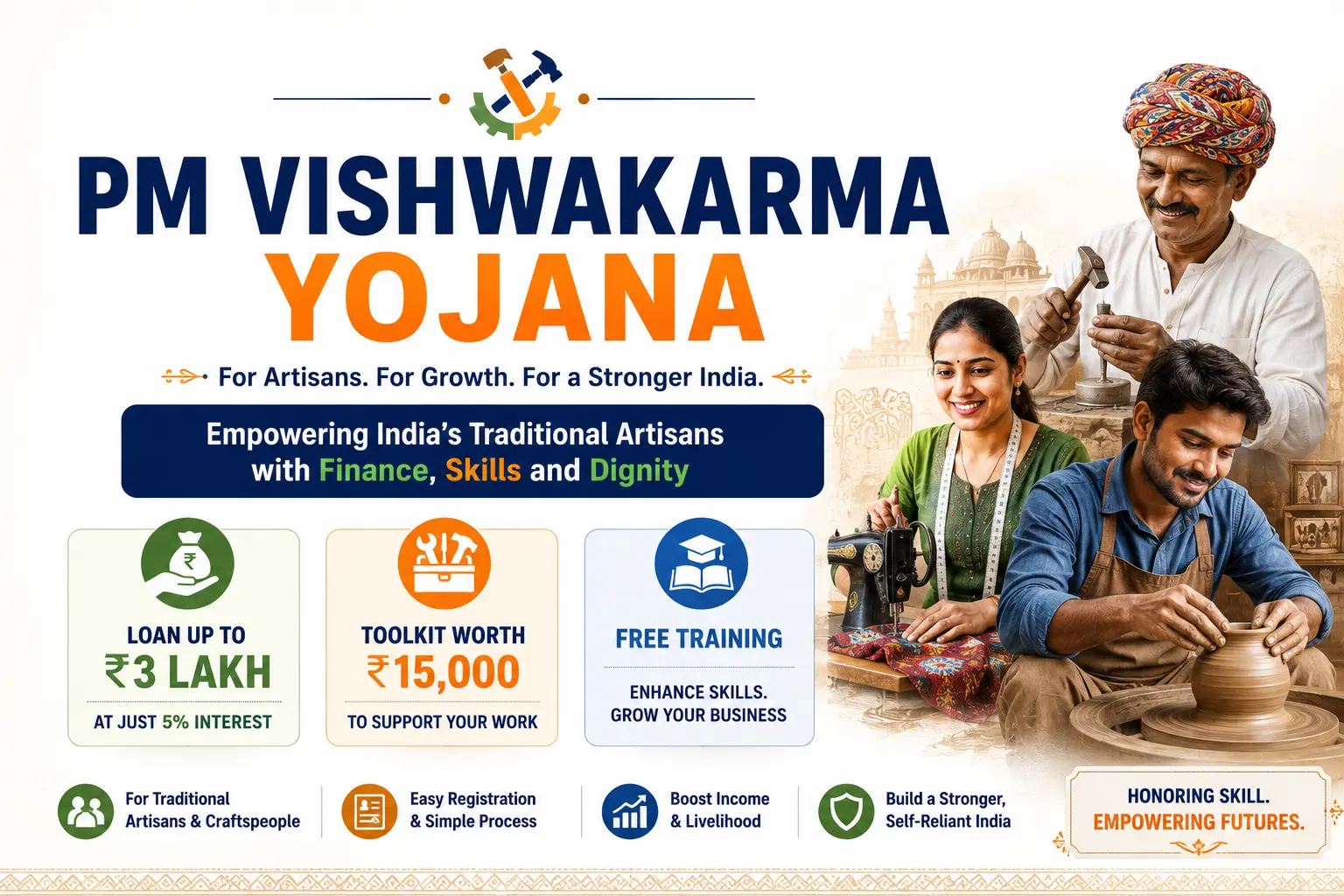
Quick selection guide: Ramk Prajapati has been making clay pots in Varanasi for thirty years. His father was a potter. [ ]
Quick selection guide:
- You are a traditional artisan in one of the 18 trades → PM Vishwakarma — apply first
- You need more than Rs.3 lakh after PM Vishwakarma → Mudra Loan
- You want to start a new manufacturing unit with government subsidy → PMEGP
- You are SC/ST or a woman starting a new enterprise above Rs.10 lakh → Stand Up India
Ramk Prajapati has been making clay pots in Varanasi for thirty years. His father was a potter. His grandfather was a potter. The Prajapati family has been shaping clay on the banks of the Ganga for three generations.
For thirty years, Ram sold his pots at the local market. Cash transactions only. No bank account in his own name. No formal business registration. No government recognition of any kind. To the formal economy, he did not exist.
When a neighbour told him about PM Vishwakarma Yojana, he was skeptical. Government schemes, in his experience, were for people with connections and paperwork — not for potters with clay-stained hands.
He went to his nearest Common Service Centre anyway.
What happened in the next six months changed the way he thinks about his craft and his future.
He received a PM Vishwakarma Certificate and a unique 12-digit Vishwakarma ID — the first formal government recognition of his trade in thirty years. He completed 7 days of skill training and earned Rs.3,500 in stipend — Rs.500 per day. He received a Rs.15,000 toolkit e-voucher and bought a new electric wheel and quality clay tools he could never afford before.
Then he applied for his first bank loan — Rs.1 lakh at 5% interest. No collateral. No guarantor. Just his PM Vishwakarma certificate and a project report generated at MudraReady.in for Rs.399.
Sanctioned in 3 weeks.
He repaid the Rs.1 lakh in 16 months. Applied for the second tranche — Rs.2 lakh at 5% — to buy an electric kiln that fires pottery in 6 hours instead of 2 days.
Approved.
Ram still makes clay pots. But now he is a recognised artisan with a bank account, a loan history, a formal business, and a kiln that produces four times the output of his old wood-fire method.
This guide covers everything about PM Vishwakarma Yojana — all 18 eligible trades, all four benefits with real rupee figures, the exact registration process, how to claim your toolkit, how to get the loan, and how to combine this scheme with Mudra and PMEGP for artisans who need more than Rs.3 lakh.
What You Will Learn in This Guide:
✅ What PM Vishwakarma Yojana is — and why it is different from every other scheme
✅ All 18 eligible trades — complete list with examples
✅ Four benefits explained with real rupee amounts — loan, toolkit, training, recognition
✅ Loan tranche structure — Rs.1 lakh then Rs.2 lakh — with EMI calculation
✅ Step by step registration at pmvishwakarma.gov.in and CSC centres
✅ Skill training — what happens, how long, and how much stipend you earn
✅ How to claim your Rs.15,000 toolkit e-voucher
✅ Project report — what banks need for PM Vishwakarma loan
✅ Combining PM Vishwakarma with Mudra and PMEGP for larger funding
✅ Full scheme comparison — PM Vishwakarma vs Mudra vs PMEGP vs Stand Up India
✅ 5 real rejection cases with exact fixes
✅ 10 FAQs — every question artisans ask
Table of Contents
What Is PM Vishwakarma Yojana
PM Vishwakarma Yojana — officially called Pradhan Mantri Vishwakarma Kaushal Samman (PM-VIKAS) — is a central government scheme launched by Prime Minister Narendra Modi on September 17, 2023, exclusively for traditional artisans and craftspeople who work with their hands and tools.
The scheme is run by the Ministry of MSME and targets the backbone of India's traditional economy — the potters, carpenters, blacksmiths, goldsmiths, tailors, cobblers, barbers, masons, and 10 other trades who have practised their craft for generations but have never been formally recognised or financially supported by the banking system.
According to pmvishwakarma.gov.in, over 30 lakh artisans have already registered under this scheme as of early 2026 — confirming that India's traditional craftspeople are actively engaging with it.
What makes PM Vishwakarma different from every other government loan scheme:
Every other scheme — Mudra, PMEGP, CGTMSE, Stand Up India — is primarily a loan scheme. PM Vishwakarma is a complete artisan support package. The loan is just one of four benefits. The other three — formal recognition, free skill training with paid stipend, and a toolkit grant — are equally valuable and available even to artisans who do not need or qualify for a loan.
PM Vishwakarma Yojana — Key Facts 2026:
| Feature | Details |
|---|---|
| Launch Date | September 17, 2023 |
| Scheme Duration | 2023-24 to 2027-28 |
| Total Budget | Rs.13,000 crore |
| Eligible Trades | 18 traditional trades |
| Maximum Loan | Rs.3 lakh (in 2 tranches) |
| Interest Rate | 5% — government subsidises remaining 8% |
| Toolkit Grant | Rs.15,000 as e-voucher |
| Training Stipend | Rs.500 per day during training |
| Collateral | None required |
| Registration Portal | pmvishwakarma.gov.in |
| Artisans Registered | 30+ lakh as of early 2026 |
All 18 Eligible Trades — Complete List
PM Vishwakarma covers exactly 18 traditional trades. If your occupation is on this list — you are potentially eligible.
| # | Trade | Who This Covers |
|---|---|---|
| 1 | Carpenter (Suthar/Badhai) | Furniture makers, wood carvers, door and window frame makers |
| 2 | Boat Maker | Traditional wooden boat builders |
| 3 | Armourer | Traditional weapon makers and repairers |
| 4 | Blacksmith (Lohar) | Iron tool makers, agricultural implement makers, gate fabricators |
| 5 | Hammer and Tool Kit Maker | Traditional hand tool manufacturers |
| 6 | Locksmith | Lock makers and repairers |
| 7 | Goldsmith (Sonar) | Jewellery makers and repairers |
| 8 | Potter (Kumhaar) | Clay pot makers, ceramic artisans |
| 9 | Sculptor (Moortikar/Stone Carver) | Idol makers, stone carving artisans |
| 10 | Stone Breaker | Stone cutting and breaking artisans |
| 11 | Cobbler/Shoesmith (Charmkar) | Shoe makers and repairers, leather artisans |
| 12 | Mason (Rajmistri) | Traditional construction workers, brick layers |
| 13 | Basket/Mat/Broom Maker/Coir Weaver | Bamboo and cane craft artisans |
| 14 | Doll and Toy Maker (Traditional) | Handmade traditional toy makers |
| 15 | Barber (Naai) | Traditional barbers operating independently |
| 16 | Garland Maker (Malakaar) | Flower garland makers |
| 17 | Washerman (Dhobi) | Traditional laundry service providers |
| 18 | Tailor (Darzi) | Traditional tailors — hand stitching and basic machine stitching |
| 19 | Fishing Net Maker | Traditional fishing net weavers and repairers |
Important clarification on Trade 18 — Tailor:
The tailor category under PM Vishwakarma covers traditional tailors (Darzi) — individual artisans who stitch clothes by hand or with basic machines as a traditional craft. It does not cover large garment manufacturing units with multiple machines and employees. If you run a garment manufacturing business — PMEGP is more appropriate. If you are an individual traditional tailor — PM Vishwakarma is your scheme.
Important clarification on Trade 4 — Blacksmith:
Blacksmiths who also do fabrication work — iron grilles, gates, railings — are covered under PM Vishwakarma for their traditional blacksmithing activity. However if their business has grown into a full fabrication workshop, they may be better served by a Mudra loan. The two schemes can be combined — more on this in Section 10.
Four Benefits — What You Actually Get
PM Vishwakarma is the only government scheme that bundles four separate benefits into one application. Most articles only mention the loan. Here is the full picture.
| Benefit | What You Get | Value |
|---|---|---|
| Recognition | PM Vishwakarma Certificate + unique 12-digit ID card | Priceless — first formal government identity for your trade |
| Skill Training | Basic training 5-7 days + advanced training 15+ days — with Rs.500/day stipend | Rs.2,500 to Rs.3,500 basic + Rs.7,500 advanced if selected |
| Toolkit Grant | Rs.15,000 as e-RUPI voucher to buy trade-specific tools | Rs.15,000 |
| Credit Support | Rs.1 lakh at 5% (Tranche 1) + Rs.2 lakh at 5% (Tranche 2) after repayment | Rs.3 lakh total at concessional 5% rate |
| Digital Incentive | Rs.1 per digital transaction — for accepting digital payments | Ongoing monthly benefit |
| Total Financial Value | Rs.18,000+ in grants + Rs.3 lakh at 5% |
The recognition benefit — why it matters more than it seems:
Before PM Vishwakarma, Ram had no formal proof that he was a potter. He could not open a current account. He could not apply for any government scheme. He was invisible to the banking system. The PM Vishwakarma Certificate and ID card gave him a formal identity as a registered artisan — making him eligible for banking services, government schemes, and GeM (Government e-Marketplace) registration to sell his products directly to government buyers.
Loan Amount and Interest Rate — Tranche 1 and Tranche 2 With Real Numbers
The PM Vishwakarma loan has a unique two-tranche structure that rewards timely repayment with access to a larger loan.
Loan structure:
| Feature | Tranche 1 | Tranche 2 |
|---|---|---|
| Loan Amount | Up to Rs.1,00,000 | Up to Rs.2,00,000 |
| Interest Rate | 5% per annum | 5% per annum |
| Government Subsidy | 8% subvention — government pays the bank the difference | Same |
| Repayment Period | 18 months | 30 months |
| Collateral | None required | None required |
| Eligibility for Tranche 2 | Must complete Tranche 1 repayment satisfactorily | Available after Tranche 1 NPA-free repayment |
Real EMI calculation — Tranche 1:
Loan: Rs.1,00,000 at 5% per annum over 18 months
| Month | Opening Balance (Rs.) | EMI (Rs.) | Principal (Rs.) | Interest (Rs.) | Closing Balance (Rs.) |
|---|---|---|---|---|---|
| 1 | 1,00,000 | 5,956 | 5,540 | 417 | 94,460 |
| 6 | 72,000 | 5,956 | 5,716 | 240 | 66,284 |
| 12 | 40,000 | 5,956 | 5,873 | 83 | 34,127 |
| 18 | 5,932 | 5,956 | 5,932 | 24 | 0 |
| Total | Rs.1,07,208 | Rs.1,00,000 | Rs.7,208 |
Ram's actual cost: He borrowed Rs.1 lakh. Over 18 months he paid Rs.7,208 in total interest — less than Rs.400 per month in interest charges. Compare this to a moneylender who would charge 24-36% annually — saving him Rs.19,000 to Rs.29,000 in interest on the same loan amount.
Real EMI calculation — Tranche 2:
Loan: Rs.2,00,000 at 5% per annum over 30 months
| Year | Opening Balance (Rs.) | Annual Repayment (Rs.) | Closing Balance (Rs.) |
|---|---|---|---|
| Year 1 | 2,00,000 | 84,192 | 1,15,808 |
| Year 2 | 1,15,808 | 84,192 | 31,616 |
| Year 3 (6 months) | 31,616 | 32,400 | 0 |
Monthly EMI for Tranche 2: Rs.7,016 per month. Total interest paid over 30 months: Rs.10,480.
Use MudraReady's free EMI Calculator to calculate your exact repayment schedule.
Who Is Eligible — Complete Criteria
Basic eligibility requirements:
| Criteria | Requirement |
|---|---|
| Citizenship | Indian resident — any state or union territory |
| Age | Minimum 18 years — no upper age limit |
| Trade | Must be engaged in one of the 18 listed trades |
| Work Style | Must work primarily with hands and tools — traditional craft practice |
| Family Restriction | Only one member per family can register — family defined as husband, wife, and unmarried children |
| Government Employment | Should not be a government employee or government employee's family member |
| Previous Scheme | Should not have availed PMEGP, PM SVANidhi, or Mudra loan in the previous 5 years (for the same trade) |
| Income | No income ceiling — any artisan regardless of income can apply |
| Registration | Must register at pmvishwakarma.gov.in through CSC |
Who is NOT eligible:
❌ Artisans working in trades not on the 18-trade list
❌ More than one family member from the same household
❌ Government employees or their family members
❌ Artisans who received PMEGP or Mudra loan for the same trade activity within the last 5 years
❌ Large manufacturing units — PM Vishwakarma is for individual artisans, not factories
The family restriction — important clarification:
Only one person per family can register under PM Vishwakarma. If a husband is a carpenter and his wife is a tailor — only one of them can register, even though both trades are on the eligible list. The family is defined as husband, wife, and unmarried children living in the same household.
How to Register — Step by Step Guide
PM Vishwakarma registration cannot be done independently online at home — it must be done through a Common Service Centre (CSC). This is a government mandate to ensure accurate verification of artisan identity and trade.
Step 1 — Find your nearest CSC
Go to locator.csccloud.in or simply search "CSC centre near me" on Google Maps. CSC centres are present in every gram panchayat and urban ward across India. They are government-authorised digital service centres — registration is free.
Step 2 — Carry these documents to the CSC:
| Document | Purpose |
|---|---|
| Aadhaar Card | Identity verification — mandatory |
| Mobile number linked to Aadhaar | OTP verification |
| Bank account details | For DBT payments — stipend and toolkit voucher |
| Caste/community self-declaration | For trade verification |
| Any tool or photo showing your trade | Some CSC operators ask for trade verification evidence |
Step 3 — CSC operator registers you on pmvishwakarma.gov.in
The CSC operator logs into the PM Vishwakarma portal with their credentials and registers you as a new artisan. Your Aadhaar is verified biometrically. Your trade is selected from the 18-trade list. Your bank account is linked for direct benefit transfer.
Step 4 — Three-tier verification
Your application goes through three stages of government verification:
| Stage | Verifying Authority | Purpose |
|---|---|---|
| Stage 1 | Gram Panchayat or Urban Local Body | Verifies you actually practice the stated trade |
| Stage 2 | DLIC (District Level Implementation Committee) | Reviews and approves at district level |
| Stage 3 | SLMC (State Level Monitoring Committee) | Final state-level approval |
This process typically takes 15 to 30 days. You can check your application status at pmvishwakarma.gov.in using your Aadhaar number or application reference number.
Step 5 — Receive PM Vishwakarma Certificate and ID
After three-tier verification, you receive your PM Vishwakarma Certificate and unique 12-digit ID card digitally — downloadable from the portal. This is your formal recognition as a registered artisan.
Step 6 — Training notification
After receiving your certificate, the District MSME-DI or DIC will notify you about the schedule for your basic skill training. Training is mandatory before you can claim the toolkit or apply for the loan.
Skill Training — Duration, Stipend and What to Expect
Training under PM Vishwakarma is free and comes with a daily stipend — meaning you are paid to attend.
Training structure:
| Training Type | Duration | Stipend | Content |
|---|---|---|---|
| Basic Training | 5 to 7 working days (40 hours) | Rs.500 per day | Trade-specific skill upgradation, financial literacy, digital payments, GST basics, e-marketplace onboarding (GeM, ONDC) |
| Advanced Training | 15 days or more | Rs.500 per day | Advanced trade skills, export market awareness, quality certification, digital marketing |
Training stipend — how much you actually earn:
| Training Duration | Daily Stipend | Total Stipend Earned |
|---|---|---|
| 5-day basic training | Rs.500 | Rs.2,500 |
| 7-day basic training | Rs.500 | Rs.3,500 |
| 15-day advanced training | Rs.500 | Rs.7,500 |
| 7-day basic + 15-day advanced | Rs.500 | Rs.11,000 |
Ram's training experience: He attended 7 days of basic training at a government training centre in Varanasi. He learned how to use digital payment systems — UPI and QR codes — which he now uses to accept payments from customers who visit his stall. He also learned about GeM registration and now sells decorative pottery to government offices through the GeM portal. The training content was more practical than he expected.
Important: The stipend is paid directly to your Aadhaar-linked bank account through Direct Benefit Transfer (DBT). You must have an active bank account before training begins. If you do not have one, open a zero-balance Jan Dhan account at any bank with your Aadhaar.
Toolkit Grant — How to Claim Your Rs.15,000 e-Voucher
The Rs.15,000 toolkit grant is one of the most practically valuable benefits under PM Vishwakarma — and also the most misunderstood.
How the toolkit grant works:
The grant is NOT given as cash. It is issued as an e-RUPI voucher — a digital voucher that can be redeemed at government-approved tool suppliers for trade-specific equipment. You cannot use it to buy groceries, pay rent, or purchase anything outside approved tool categories.
Step-by-step process to claim your toolkit:
Step 1: Complete your basic skill training and receive your training completion certificate.
Step 2: After training, your toolkit eligibility is activated on the PM Vishwakarma portal automatically.
Step 3: Your CSC operator or District MSME-DI will inform you about approved tool suppliers in your area — these are listed on the portal by trade category.
Step 4: Visit an approved supplier. Show your PM Vishwakarma ID. The supplier verifies your e-RUPI voucher on their system.
Step 5: Select tools from the approved list for your trade. Total purchase value up to Rs.15,000.
Step 6: Supplier redeems the e-RUPI voucher digitally. No cash changes hands.
What artisans buy with the toolkit grant — by trade:
| Trade | Common Toolkit Purchases |
|---|---|
| Potter (Kumhaar) | Electric wheel, clay tools, measuring instruments, glazing equipment |
| Carpenter (Suthar) | Power drill, sander, measuring tools, chisels, saw set |
| Tailor (Darzi) | Improved sewing machine parts, cutting tools, measuring tape, embroidery tools |
| Blacksmith (Lohar) | Improved anvil, hammers, tongs, grinder accessories |
| Goldsmith (Sonar) | Precision weighing scale, soldering equipment, design tools |
| Barber (Naai) | Professional clippers, scissors set, styling tools |
| Mason (Rajmistri) | Measuring tools, trowel set, plumb bob, spirit level |
| Cobbler (Charmkar) | Stitching tools, lasting pincers, finishing equipment |
PM Vishwakarma Project Report — What Banks Need
Unlike PMEGP or Stand Up India where the project report is the most complex document, PM Vishwakarma loan applications require a simplified project report — because the loans are smaller and the purpose is well-defined.
However, banks still require a structured project report before sanctioning even the Rs.1 lakh Tranche 1 loan. The format is simpler than a full IBA-standard report but must contain specific sections.
PM Vishwakarma project report — required sections:
| Section | What to Include |
|---|---|
| Artisan Profile | Name, address, trade, years of experience, PM Vishwakarma ID number |
| Business Description | What you make or do, who your customers are, how you sell |
| Project Cost Statement | What you will buy with the Rs.1 lakh — tools, raw materials, working capital |
| Working Capital Requirement | Monthly raw material cost, labour, other expenses |
| Revenue Projection | Current monthly income + projected income after loan |
| Repayment Plan | How you will repay Rs.5,956 per month from your craft income |
| DSCR Calculation | Must show minimum 1.25 — even for small loans |
Real DSCR example for Ram — Tranche 1:
| Item | Monthly Amount (Rs.) |
|---|---|
| Current monthly income from pottery | 12,000 |
| Expected income increase after toolkit + loan (new electric wheel) | 6,000 |
| Total projected monthly income | 18,000 |
| Monthly expenses — clay, firing, transport | 7,000 |
| Net monthly profit | 11,000 |
| Monthly EMI for Rs.1 lakh at 5% over 18 months | 5,956 |
| DSCR = (Rs.11,000 × 12) ÷ (Rs.5,956 × 12) | = 1.85 ✅ |
A DSCR of 1.85 is strong for a Rs.1 lakh loan. Bank sanctioned in 3 weeks.
Generate your PM Vishwakarma project report — Rs.399, 10 minutes, first report FREE.
Check your DSCR before applying: MudraReady's free DSCR Calculator
Combine PM Vishwakarma With Mudra and PMEGP
PM Vishwakarma's Rs.3 lakh maximum covers basic needs for most traditional artisans. But some artisans want to scale beyond traditional craft — opening a proper workshop, hiring apprentices, supplying to retail chains or export markets. For these artisans, combining PM Vishwakarma with other schemes unlocks significantly more funding.
Combination 1 — PM Vishwakarma + Mudra Loan:
This is the most practical combination for artisans who have completed PM Vishwakarma and want to expand.
| Stage | Scheme | Amount | Purpose |
|---|---|---|---|
| Phase 1 | PM Vishwakarma Tranche 1 | Rs.1,00,000 | Basic tools, raw materials, working capital |
| Phase 2 | PM Vishwakarma Tranche 2 | Rs.2,00,000 | Better equipment, expanded inventory |
| Phase 3 | Mudra Kishor or Tarun | Rs.2L to Rs.10L | Workshop expansion, employees, machinery |
Ram's plan: After repaying Tranche 2 (Rs.2 lakh), he plans to apply for a Mudra Tarun loan of Rs.5 lakh to build a proper pottery studio with 3 electric kilns, hire 2 assistants, and supply directly to craft stores in Varanasi and Delhi.
Important condition: PM Vishwakarma guidelines state that artisans who availed Mudra loan within the last 5 years for the same trade are not eligible for PM Vishwakarma registration. However, artisans who complete PM Vishwakarma and then apply for Mudra — in the other direction — are eligible. Sequence matters: PM Vishwakarma first, then Mudra.
For full Mudra loan details: Mudra Loan Complete Guide
Combination 2 — PM Vishwakarma + PMEGP (for manufacturing artisans):
For artisans who want to transition from individual craft practice to a proper manufacturing unit — PMEGP's 25-35% subsidy combined with PM Vishwakarma's recognition and training creates a powerful foundation.
| Component | Scheme | Value |
|---|---|---|
| Initial tools and working capital | PM Vishwakarma Tranche 1 | Rs.1 lakh at 5% |
| Formal recognition and training | PM Vishwakarma | Rs.15,000 toolkit + Rs.3,500 stipend |
| Manufacturing unit expansion | PMEGP | Up to Rs.50 lakh with 25-35% subsidy |
This combination requires separate applications to KVIC (for PMEGP) and your bank (for PM Vishwakarma). Both applications must be disclosed to both agencies. The PM Vishwakarma loan and PMEGP loan can co-exist as they fund different components of the artisan's business journey.
For full PMEGP details: PMEGP Loan Complete Guide 2026
Combination 3 — PM Vishwakarma for SC/ST or Women artisans + Stand Up India:
SC/ST artisans and women artisans who register under PM Vishwakarma and then want to scale to a larger enterprise can subsequently apply for Stand Up India — which provides Rs.10 lakh to Rs.1 crore. The PM Vishwakarma recognition, training certificate, and loan repayment track record significantly strengthens a Stand Up India application.
For full Stand Up India details: Stand Up India Complete Guide 2026
PM Vishwakarma vs Mudra vs PMEGP vs Stand Up India — Full Comparison
| Feature | PM Vishwakarma | Mudra Loan | PMEGP | Stand Up India |
|---|---|---|---|---|
| Maximum Loan | Rs.3 lakh | Rs.20 lakh | Rs.50 lakh | Rs.1 crore |
| Interest Rate | 5% — concessional | 8-12% market rate | Market rate | MCLR + 3% |
| Government Subsidy | 8% interest subvention + Rs.15,000 toolkit + training | None | 25-35% of project cost | None |
| Non-Repayable Grant | Rs.15,000 toolkit + Rs.500/day stipend | None | 25-35% subsidy | None |
| Who Can Apply | Traditional artisans in 18 trades only | Any Indian with a business | Any new business — most sectors | SC/ST and women only |
| New Business Only | No — existing artisans eligible | No — new and existing | Yes — new only | Yes — new only |
| Collateral | None | None | None up to Rs.10L | CGTMSE covers it |
| Recognition | PM Vishwakarma Certificate and ID | None | None | None |
| Training | Free — with paid stipend | None | EDP training — free | None |
| Processing Time | 4-8 weeks | 1-3 weeks | 2-4 months | 6-16 weeks |
| Best For | Traditional artisans in 18 trades | Any business — quick loan | New manufacturing with subsidy | SC/ST or women — large new enterprise |
5 Reasons Applications Get Rejected — Real Cases and Exact Fixes
Reason 1 — Trade Not on the Eligible List
What happened: Suresh Yadav from Bihar applied under PM Vishwakarma as a weaver — he makes traditional silk sarees on a handloom. His CSC operator registered him under "Basket/Mat/Broom Maker/Coir Weaver" — Trade 13 — which was the closest match available. His application was rejected at the Gram Panchayat verification stage. Reason: "Handloom weaving is covered under the separate Handloom Scheme — not PM Vishwakarma."
The fix: Handloom weavers, powerloom workers, and most textile workers are covered under the Ministry of Textiles' separate handloom schemes — not PM Vishwakarma. Suresh applied for a Mudra Kishor loan instead — received Rs.3 lakh for loom upgradation. If you are a weaver, embroiderer working with fabric rather than making baskets or mats — PM Vishwakarma may not be the right scheme. Confirm with your nearest DIC office before registering. Read: Mudra Loan Guide
Reason 2 — Two Family Members Applied
What happened: Anita and her husband Mohan — both tailors — both registered separately under PM Vishwakarma at their local CSC centre. Two separate applications, two different CSC sessions, two different mobile numbers. Both applications were rejected at the DLIC verification stage. Reason: "Same household — only one registration permitted per family."
The fix: The family restriction is strictly enforced through Aadhaar address matching. Both Anita and Mohan shared the same Aadhaar address — the system identified them as the same household. They decided Anita should apply — she is a women artisan and received priority processing. Mohan will apply for a Mudra Kishor loan for the same tailoring business instead. Only the first application was valid — the second was automatically rejected.
Reason 3 — Availed Mudra Loan in the Last 5 Years
What happened: Prabhavati Devi, a potter from Rajasthan, had taken a Mudra Shishu loan of Rs.30,000 in 2022 for buying clay and tools. She applied for PM Vishwakarma in 2026 — within 5 years of her Mudra loan. Her application was rejected. Reason: "Applicant availed Mudra loan for the same trade within 5 years — not eligible for PM Vishwakarma registration."
The fix: This is an eligibility condition that cannot be appealed. Prabhavati had to wait until 2027 — five years after her 2022 Mudra loan — before applying for PM Vishwakarma. In the meantime, she applied for a Mudra Kishor loan of Rs.2 lakh for her pottery business expansion — which was approved since Mudra has no such restriction on repeat applications.
Reason 4 — Weak Project Report for Loan Application
What happened: Govind Ram — a carpenter from Uttar Pradesh — received his PM Vishwakarma certificate, completed training, claimed his toolkit, and applied for the Tranche 1 Rs.1 lakh loan. His bank asked for a project report. He submitted a one-page handwritten document showing his monthly income and what he planned to buy.
The bank returned it: "Project report format not acceptable — DSCR calculation missing, revenue projections not included, project cost breakdown not provided."
The fix: Even for a Rs.1 lakh PM Vishwakarma loan, banks require a structured project report. Govind generated his at MudraReady.in — Rs.399, 10 minutes. The report included his current income, projected income increase after buying the new power drill and router, DSCR calculation showing 1.72, and a month-by-month repayment plan. Bank sanctioned in 2 weeks.
Reason 5 — Bank Account Not Linked to Aadhaar
What happened: Kalawati Devi — a traditional toy maker from Madhya Pradesh — completed registration, verification, and training successfully. When the toolkit e-voucher was to be issued, the transfer failed. When the training stipend was to be credited, it failed. Reason: "Bank account not linked to Aadhaar — DBT payments cannot be processed."
She was also unable to apply for the loan because the bank required her account to be Aadhaar-linked for the PM Vishwakarma loan application.
The fix: Before going to the CSC for registration, visit your bank and get your bank account linked to your Aadhaar. This is a 10-minute process at any bank branch — bring your Aadhaar and your bank passbook. If you do not have a bank account, open a zero-balance Jan Dhan account at any nationalised bank with just your Aadhaar. Both the toolkit voucher and training stipend are transferred via DBT — Aadhaar-bank linkage is mandatory for both.
Frequently Asked Questions
What is the PM Vishwakarma Yojana and who can apply?
PM Vishwakarma Yojana is a central government scheme launched September 17, 2023, for traditional artisans and craftspeople in 18 designated trades. It provides formal recognition, free skill training with Rs.500 per day stipend, a Rs.15,000 toolkit grant, and collateral-free loans up to Rs.3 lakh at a concessional 5% interest rate. Any Indian artisan aged 18 or above who practices one of the 18 listed trades and has not availed a Mudra loan for the same trade in the last 5 years can apply.
What are all 18 trades eligible under PM Vishwakarma?
The 18 eligible trades are: Carpenter, Boat Maker, Armourer, Blacksmith, Hammer and Tool Kit Maker, Locksmith, Goldsmith, Potter, Sculptor/Stone Carver, Stone Breaker, Cobbler/Shoesmith, Mason, Basket/Mat/Broom Maker/Coir Weaver, Doll and Toy Maker, Barber, Garland Maker, Washerman, Tailor, and Fishing Net Maker. If your trade is not on this list, apply for a Mudra loan instead.
How much loan does PM Vishwakarma give and at what interest rate?
PM Vishwakarma gives collateral-free enterprise development loans in two tranches — Rs.1 lakh at 5% interest over 18 months (Tranche 1) and Rs.2 lakh at 5% interest over 30 months (Tranche 2) after successful repayment of Tranche 1. The government subsidises 8% of the interest — you pay only 5%. On a Rs.1 lakh loan, total interest paid over 18 months is approximately Rs.7,208 — less than Rs.400 per month in interest charges.
How do I register for PM Vishwakarma Yojana?
Registration must be done through a Common Service Centre (CSC) — you cannot register independently online at home. Go to your nearest CSC with your Aadhaar card, Aadhaar-linked mobile number, and bank account details. The CSC operator registers you on pmvishwakarma.gov.in at no charge. After three-tier verification (Gram Panchayat, DLIC, SLMC), you receive your PM Vishwakarma Certificate and ID card within 15-30 days.
What is the Rs.15,000 toolkit grant and how do I get it?
The Rs.15,000 toolkit grant is issued as an e-RUPI voucher — a digital voucher redeemable at government-approved tool suppliers for trade-specific equipment. You receive it after completing your basic skill training. The voucher is activated on the PM Vishwakarma portal and can be redeemed by visiting an approved supplier in your district, showing your PM Vishwakarma ID, and selecting tools from the approved list. It cannot be converted to cash.
s skill training mandatory before getting the PM Vishwakarma loan?
I
Yes — basic skill training is mandatory before you can claim the toolkit grant or apply for the Tranche 1 loan. Training is 5 to 7 days and comes with a Rs.500 per day stipend credited to your bank account. The District MSME-DI or DIC will notify you of the training schedule after your PM Vishwakarma certificate is issued. Training is free and conducted at government-designated training centres.
Can I apply for PM Vishwakarma if I already have a Mudra loan?
If you took a Mudra loan for the same trade within the last 5 years — you cannot apply for PM Vishwakarma for that trade until 5 years have passed. If you took a Mudra loan more than 5 years ago — you are eligible. If you took a Mudra loan for a completely different purpose or business — check with your DIC office. After completing PM Vishwakarma and repaying the tranches, you can apply for a Mudra loan for further expansion — the restriction only applies in the PM Vishwakarma direction.
What project report do I need for the PM Vishwakarma loan?
Banks require a structured project report even for the Rs.1 lakh Tranche 1 loan. The report should include your artisan profile with PM Vishwakarma ID, business description, project cost breakdown showing what you will buy with the loan, monthly revenue projection before and after the loan, DSCR calculation (minimum 1.25), and a repayment plan. Generate your PM Vishwakarma project report at MudraReady.in — Rs.399, 10 minutes.
Can SC/ST and women artisans get extra benefits under PM Vishwakarma?
PM Vishwakarma does not differentiate between categories for the core benefits — all registered artisans get the same toolkit, training, and loan regardless of caste or gender. However, SC/ST and women artisans who complete PM Vishwakarma and want to scale further can combine it with Stand Up India (Rs.10 lakh to Rs.1 crore for SC/ST and women) or PMEGP (25-35% subsidy for new manufacturing units) — which do offer additional category benefits.
Conclusion — India Has Not Forgotten Its Artisans. PM Vishwakarma Is the Proof.
Ram made clay pots for thirty years before the government acknowledged his existence.
He did not need charity. He needed recognition, tools, training, and access to formal credit at a rate he could afford. PM Vishwakarma Yojana gave him all four.
Today he sells pottery on GeM, accepts UPI payments, repays a bank loan on time, and operates an electric kiln that fires four times the output of his old method. His PM Vishwakarma ID card hangs on the wall of his workshop — the first government document that says, officially, that Ram Prajapati is a potter.
If you practice one of the 18 traditional trades — your PM Vishwakarma certificate, toolkit, training stipend, and loan are waiting. The scheme is active. The registration is free. The loan is at 5%.
Artisan profile included. DSCR auto-calculated. Bank-ready PDF. Accepted at Bank of India, SBI, PNB, Canara Bank, and all PM Vishwakarma participating banks.
Sources: pmvishwakarma.gov.in | msme.gov.in | sidbi.in | udyamregistration.gov.in | PM Vishwakarma Scheme Guidelines 2023-28 | Bank of India PM Vishwakarma Scheme Document
Last Updated: July 2026
Ready to Apply for your Business Loan?
Most banks reject loans due to incorrect project reports. Create a professional, bank-compliant project report in just 5 minutes with MudraReady.
