
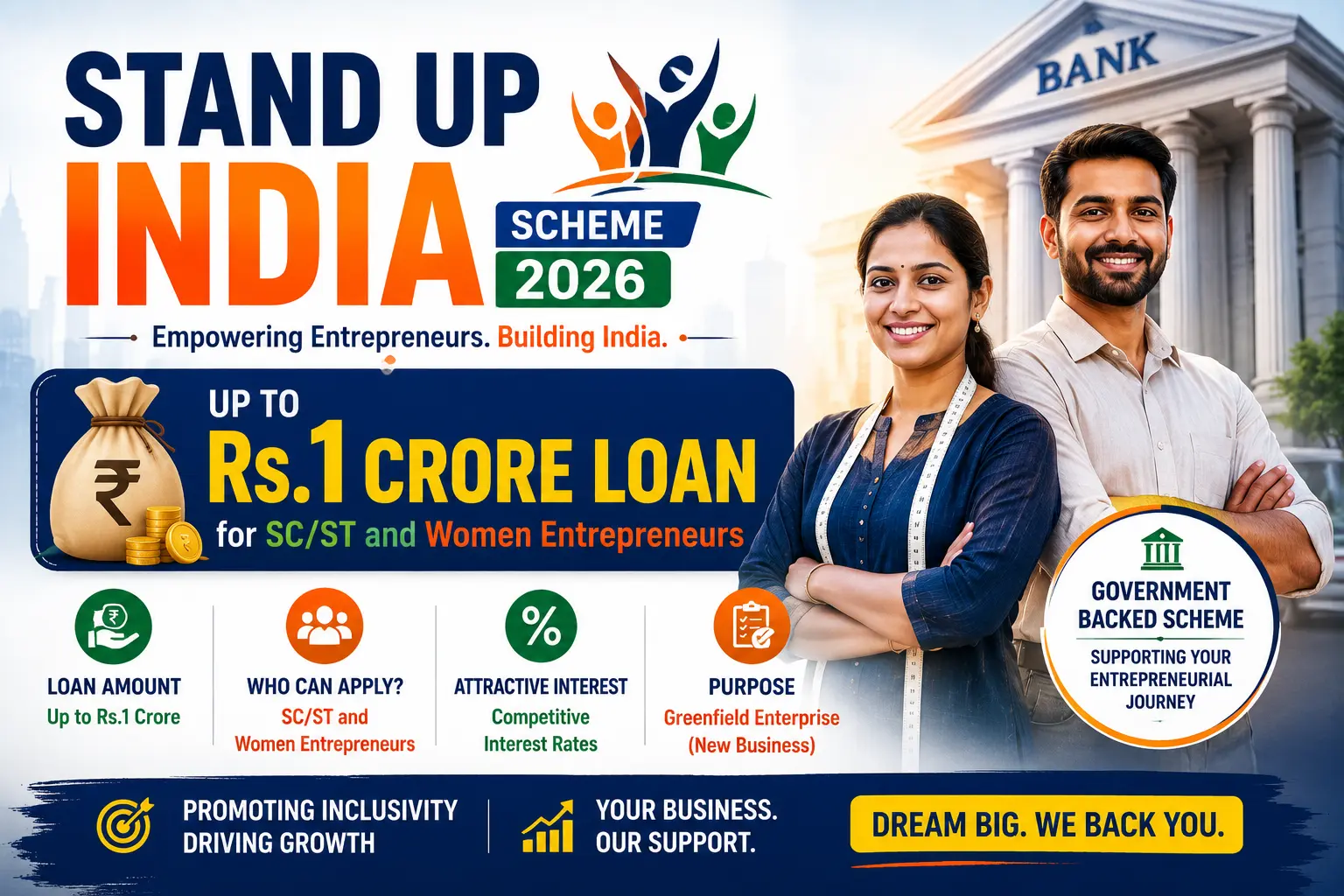
Stand Up India Scheme 2026 — Up to Rs1 Crore Loan for SC/ST and Women Entrepreneurs
Quick selection guide: Stand Up India Scheme Lakshmi Devi grew up in a small village near Coimbatore, Tamil Nadu. Her [ ]
Quick selection guide: Stand Up India Scheme
- You are SC/ST or a woman starting a new business needing Rs.10 lakh to Rs.1 crore → Stand Up India
- You want government subsidy (25-35%) for a new manufacturing unit → PMEGP — or PMEGP + Stand Up India combined
- You need a quick loan for any business — new or existing — under Rs.20 lakh → Mudra Loan
- You need above Rs.20 lakh with no property to pledge and don't qualify for Stand Up India → CGTMSE
Lakshmi Devi grew up in a small village near Coimbatore, Tamil Nadu. Her mother was a tailor. Her grandmother was a tailor. Lakshmi had been stitching clothes since she was twelve years old. By the time she was thirty-two, she had fifteen years of practical experience in garment making — patterns, cutting, finishing, quality control.
She wanted her own unit. Ten machines. Three full-time workers. A proper registered manufacturing business.
Total project cost: Rs.25 lakh.
She had Rs.3.75 lakh in savings. She needed Rs.21.25 lakh.
Every bank she approached told her the same thing — collateral. Property. Security. She had none. Her family home was in her father's name. She had no fixed assets of her own.
Then a neighbour mentioned Stand Up India.
Lakshmi belonged to a Scheduled Caste. She was a woman. She wanted to start a new manufacturing business. She was exactly who this scheme was designed for.
She applied through standupmitra.in. Generated her project report at MudraReady.in — Rs.399, 10 minutes. Her loan of Rs.21.25 lakh was sanctioned at Canara Bank. CGTMSE provided the guarantee — no collateral required. Her garment unit started operations four months later.
Today she employs seven women from her village.
This guide covers everything about Stand Up India — the greenfield rule explained clearly, the 51% stake requirement, how the loan amount is calculated, how to combine this scheme with PMEGP and CGTMSE, and the five mistakes that get applications rejected.
What You Will Learn in This Guide:
✅ What Stand Up India is — and the mandate that makes it unique
✅ Loan amount breakdown — term loan plus working capital with real rupee figures
✅ Complete eligibility criteria — with real examples
✅ What "greenfield enterprise" actually means — the most misunderstood rule
✅ The 51% controlling stake rule — for companies and partnerships
✅ Step-by-step standupmitra.in portal application guide
✅ Project report requirements specific to Stand Up India
✅ Interest rate calculation with real numbers
✅ How to combine Stand Up India with PMEGP and CGTMSE
✅ Full scheme comparison — Stand Up India vs PMEGP vs Mudra vs CGTMSE
✅ 5 real rejection cases with exact fixes
✅ 10 FAQs — every question first-time applicants ask
Table of Contents
What Is the Stand Up India Scheme
Stand Up India is a Government of India initiative launched on April 5, 2016, to promote entrepreneurship among Scheduled Caste (SC), Scheduled Tribe (ST), and women entrepreneurs by providing institutional credit for setting up new enterprises.
The scheme is implemented through all scheduled commercial banks across India and monitored by SIDBI (Small Industries Development Bank of India). The central government has made it a mandatory banking directive — every bank branch in India must extend at least one Stand Up India loan to at least one SC/ST borrower and at least one woman borrower.
This mandate is what makes Stand Up India fundamentally different from every other government scheme. Under Mudra or PMEGP, a bank can decline your application based on credit assessment. Under Stand Up India, the bank has a government directive to fund eligible applicants at every branch. Your application is not competing with thousands of others — your branch has a specific quota to fill.
According to SIDBI's official data, over 1.8 lakh loans worth more than Rs.40,000 crore have been sanctioned under Stand Up India since its launch. Of these, over 81% of beneficiaries are women — confirming that women entrepreneurs are actively using and benefiting from this scheme.
Stand Up India — Key Facts 2026:
| Feature | Details |
| Loan Amount | Rs.10 lakh to Rs.1 crore |
| Loan Type | Composite loan — term loan plus working capital |
| Who Can Apply | SC/ST entrepreneurs and women entrepreneurs |
| Business Type | Greenfield enterprise only — new businesses |
| Sectors Covered | Manufacturing, services, trading, agriculture-allied |
| Collateral | Covered under CGTMSE guarantee |
| Repayment Period | Up to 7 years |
| Moratorium | Up to 18 months |
| Application Portal | standupmitra.in |
| Monitoring Agency | SIDBI |
Loan Amount and What It Covers — Real Rupee Breakdown
Stand Up India provides a composite loan — meaning it covers both term loan (for fixed assets like machinery and equipment) and working capital (for raw materials, salaries, and day-to-day operations) in a single loan facility.
How the loan amount is determined:
The loan covers 75% of the total project cost. The remaining 25% is the applicant's own contribution — called margin money. However, if the project is covered under any government subsidy scheme, the subsidy portion counts toward the 25% margin requirement.
Loan amount breakdown — Lakshmi's garment unit:
| Component | Amount (Rs.) | Percentage |
| Total Project Cost | 25,00,000 | 100% |
| Stand Up India Loan (75%) | 18,75,000 | 75% |
| Lakshmi's Own Contribution (15%) | 3,75,000 | 15% |
| PMEGP Subsidy (10% — if combined) | 2,50,000 | 10% |
| Total Funded | 25,00,000 | 100% |
In Lakshmi's actual case she did not combine PMEGP — her own contribution was 15% = Rs.3.75 lakh. Bank loan was Rs.21.25 lakh.
What the loan covers — term loan component:
| Asset | Cost (Rs.) |
| Industrial Sewing Machines (10 units) | 8,00,000 |
| Overlock Machines (3 units) | 90,000 |
| Cutting Tables (2 units) | 60,000 |
| Generator | 1,50,000 |
| Shed Construction | 4,00,000 |
| Electrical Fittings | 50,000 |
| Total Term Loan Component | 15,50,000 |
What the loan covers — working capital component:
| Item | Monthly (Rs.) | 3 Months (Rs.) |
| Fabric and Raw Material | 2,50,000 | 7,50,000 |
| Staff Salaries (7 workers) | 84,000 | 2,52,000 |
| Rent | 15,000 | 45,000 |
| Electricity and Utilities | 12,000 | 36,000 |
| Miscellaneous | 10,000 | 30,000 |
| Total Working Capital | 11,13,000 |
Working capital component = Rs.11.13 lakh. Term loan = Rs.15.5 lakh. But maximum loan is Rs.25 lakh and Lakshmi's entitlement was 75% = Rs.18.75 lakh. The bank structured it as Rs.12 lakh term loan + Rs.6.75 lakh working capital = Rs.18.75 lakh. The balance came from her own contribution.
Minimum and maximum loan amounts:
| Minimum Loan | Maximum Loan | Own Contribution |
| Rs.10 lakh | Rs.1 crore | Minimum 10% of project cost |
If your project cost is below Rs.13.33 lakh (which gives 75% = Rs.10 lakh), the minimum loan threshold still applies — you must borrow at least Rs.10 lakh. If your project cost is above Rs.1.33 crore, Stand Up India covers only up to Rs.1 crore — you fund the rest yourself or through another facility.
Who Is Eligible — Complete Criteria With Examples
Basic eligibility requirements:
| Criteria | Requirement | Example |
| Category | SC, ST, or Women — one or more | Lakshmi qualifies as both SC and women |
| Age | Above 18 years | No upper age limit |
| Business Status | Greenfield only — new enterprise | Existing businesses are not eligible |
| Sector | Manufacturing, services, trading, agriculture-allied | Garment manufacturing — eligible |
| Default History | Should not be a defaulter with any bank | Clean credit history required |
| Udyam Registration | Required | Register free at udyamregistration.gov.in |
| Non-individual entities | SC/ST or women must hold 51%+ controlling stake | Covered in Section 5 |
Women category — important clarification:
The women entrepreneur category under Stand Up India is open to women of all castes and communities — including general category women. A general category woman who has never received any government scheme benefit is fully eligible. The SC/ST category is separate — it is for SC or ST entrepreneurs regardless of gender.
This means a bank branch must fund:
- At least one SC or ST borrower (any gender)
- At least one woman borrower (any caste or community)
A woman who is also SC or ST fulfills both quotas simultaneously — like Lakshmi did.
Who is NOT eligible:
❌ Existing businesses — Stand Up India is for greenfield enterprises only
❌ SC/ST or women who have already availed Stand Up India benefits previously
❌ Defaulters with any bank or financial institution
❌ Non-individual entities where SC/ST or women do not hold 51%+ controlling stake
❌ Projects not in manufacturing, services, trading, or agriculture-allied sectors
What Is a Greenfield Enterprise — The Most Misunderstood Rule
The word "greenfield" is the single biggest source of confusion in Stand Up India applications. Most guides define it vaguely as "a new business." The actual definition is more specific — and more inclusive than most people assume.
Official definition:
A greenfield enterprise under Stand Up India means the first time venture of the beneficiary in the manufacturing, services, or trading sector. This means:
✅ You have never owned or co-owned a business before — you are starting fresh
✅ You may have worked as an employee for years — that does not disqualify you
✅ Your family members may own businesses — that does not disqualify you
✅ You may have a small home-based unregistered activity — that does not automatically disqualify you (check with your bank)
What disqualifies you from "greenfield" status:
❌ You currently own or co-own a registered business
❌ You have previously received Stand Up India benefits for another enterprise
❌ The enterprise is being set up in the name of someone who already has an existing business
Real examples that clarify the rule:
Priya Sharma — eligible: Has been working as a beauty technician at someone else's salon for 8 years. Wants to start her own salon. She has never owned a business. This is a greenfield enterprise. She qualifies.
Ranjit Kumar (SC category) — not eligible: Owns a small kirana shop registered as a proprietorship. Wants to start a tailoring unit separately. He already owns a business — the new unit is not his "first time venture." He does not qualify.
Sarita Devi — check with bank: Has been making pickles at home and selling them informally for 3 years — no GST, no Udyam registration, no formal business structure. Wants to formalise and expand into a proper food processing unit. This is a grey area — some banks consider the informal activity as an existing business, others do not. Sarita should apply and let the bank make the determination. In most cases, unregistered informal activities are not considered as existing businesses for Stand Up India purposes.
The 51% Controlling Stake Rule — For Companies and Partnerships
If you are applying as an individual proprietor — this section does not apply to you. Skip to Section 6.
If you are applying as a partnership firm, LLP, or private limited company — this is critical.
For non-individual entities, at least 51% of the shareholding AND controlling stake must be held by SC/ST or women entrepreneurs. Both conditions must be met simultaneously.
What "controlling stake" means:
Shareholding percentage is not enough on its own. The SC/ST or women promoter must also have actual operational control — decision-making authority, signatory rights, directorial position. A structure where a woman holds 51% shares but her husband makes all business decisions will be scrutinised carefully by the bank.
Real example — eligible structure:
Priya (women entrepreneur) and her male business partner set up a private limited company. Priya holds 51% shares and is listed as Managing Director. Her partner holds 49% shares. Priya signs cheques, attends bank meetings, and manages day-to-day operations. This qualifies — she has both 51% stake and controlling role.
Real example — not eligible:
Ram and Sita (wife) form a partnership. Sita holds 51% stake on paper. But Ram runs the business — he attends all meetings, his signature is on supplier contracts, and Sita has no operational involvement. The bank's credit officer is likely to question this structure during appraisal. If it appears to be a proxy arrangement, the application will be declined.
For existing companies wanting to pivot to Stand Up India:
If your company currently has the wrong ownership structure, you must restructure — change the shareholding agreement, update the board resolution, and update all KYC — before applying. The bank will verify the ownership structure through official documents, not just your statement.
Documents Required for Stand Up India Application
| Document | Where to Get It | Mandatory? |
| Aadhaar Card | UIDAI — uidai.gov.in | Yes |
| PAN Card | Income Tax Department | Yes |
| Caste Certificate | District Collector's office — for SC/ST | Yes — for SC/ST category |
| Project Report | MudraReady.in — Rs.399, 10 minutes | Yes — most important document |
| Udyam Registration Certificate | udyamregistration.gov.in — free, 10 minutes | Yes |
| Educational Qualification Certificate | School or college records | Helpful — not always mandatory |
| Business Plan | Included in project report | Yes |
| Bank Account Statement | Last 6 months | Yes |
| Passport Size Photos | Any photo studio — 2 copies | Yes |
| Lease Agreement or Land Documents | Landlord or revenue records | Yes — if premises involved |
| Machinery Quotations | Equipment suppliers — written quotations | Yes |
| Partnership Deed or MOA | Company registrar — for non-individual entities | Yes — if applicable |
| Resolution for 51% stake | Board resolution — for companies | Yes — for non-individual entities |
| ITR (last 2 years) | Income Tax portal | Helpful — for existing income proof |
How to Apply — Step by Step standupmitra.in Portal Guide
All Stand Up India applications are processed through the official SIDBI portal at standupmitra.in. Here is the exact process.
Step 1 — Register on standupmitra.in
Go to standupmitra.in. Click "Apply Now." Register with your name, mobile number, and email address. Verify your mobile with OTP. Complete your basic profile — category (SC/ST or women), state, district.
Step 2 — Choose Your Pathway
The portal offers three pathways:
| Pathway | Description | Choose If |
| Ready Borrower | You have a project report and all documents ready | Apply here — fastest route |
| Trainee Borrower | You need guidance before applying | Apply here if you need help with project plan |
| Seeking Hand Holding | You need mentoring and business development support | Apply here if starting from scratch |
For most applicants with a project in mind — select Ready Borrower. If you have generated your project report at MudraReady, you are a Ready Borrower.
Step 3 — Fill the Application Form
The standupmitra.in application form covers:
| Section | What to Fill |
| Personal Details | Name, address, date of birth, category, education |
| Business Details | Business name, activity, location, sector |
| Project Details | Total project cost, loan amount needed, description |
| Bank Preference | Preferred bank and branch where you want the loan |
| Financial Details | Own contribution amount, existing savings, other income |
| Employment Generation | How many people the business will employ |
Step 4 — Upload Documents
Upload all documents from Section 6 as scanned PDFs. File size limit per document is typically 2MB. Compress larger files before uploading.
Step 5 — Submit and Receive Application Number
After submission, you receive a unique application number. Save this — you will use it to track status and communicate with the bank.
Step 6 — Bank Contact
The application is forwarded to the bank branch you selected. A bank officer will contact you within 15 working days to schedule a meeting. Bring all original documents to this meeting.
Step 7 — Bank Appraisal
The bank conducts its standard credit appraisal — CIBIL check, project report review, DSCR verification, site visit if required. Processing time: 15 to 45 working days depending on the bank and branch.
Step 8 — Sanction and Disbursement
Bank sanctions the loan amount. CGTMSE guarantee is obtained (no action needed from you for this). Loan is disbursed to your account. You begin operations.
Total timeline from application to disbursement: 6 to 16 weeks for most complete applications.
Stand Up India Project Report — What It Must Contain
Stand Up India uses the same IBA-standard 14-section project report format as other bank loans — with two additional requirements specific to this scheme.
Two Stand Up India-specific additions:
1. SC/ST or Women Category Declaration
A clear statement in the executive summary declaring your category, your eligibility under Stand Up India, and confirming this is your first entrepreneurial venture (greenfield declaration). This declaration must be signed by you and supported by relevant certificates.
2. Employment Generation Statement
Stand Up India tracks job creation as a scheme objective. Your project report must include an explicit employment generation section — how many people you will employ directly (full-time), semi-directly (part-time, contract), and indirectly (suppliers, service providers). Lakshmi's project report showed 7 direct employees and 3 indirect (fabric supplier, transporter, packaging vendor).
DSCR requirement for Stand Up India:
Minimum 1.25 for service sector businesses. Minimum 1.50 for manufacturing businesses. Lakshmi's garment unit — manufacturing — required DSCR of 1.50 or above.
Her DSCR calculation:
| Item | Annual Amount (Rs.) |
| Net Annual Profit (Year 1) | 3,20,000 |
| Depreciation (machinery at 15% WDV) | 1,35,000 |
| Interest on Term Loan | 1,53,000 |
| Net Operating Income | 6,08,000 |
| Annual Loan Repayment | 2,67,857 |
| Interest on Term Loan | 1,53,000 |
| Annual Debt Service | 4,20,857 |
| DSCR = Rs.6,08,000 ÷ Rs.4,20,857 | = 1.44 |
Lakshmi's DSCR was 1.44 — above the minimum 1.25 but slightly below the preferred 1.50 for manufacturing. The bank accepted it because her category (SC/ST women) gave them higher confidence and the CGTMSE guarantee removed their collateral risk entirely.
Generate your Stand Up India project report — Rs.399, 10 minutes, first report FREE.
Also check your DSCR before applying: MudraReady's free DSCR Calculator
Interest Rate and Repayment Terms
Interest rate formula:
Stand Up India mandates that the interest rate should not exceed the bank's lowest applicable rate for that category — structured as:
Interest Rate = Bank's Base Rate (MCLR) + 3% + Tenor Premium
Real example — Canara Bank 2026:
| Component | Rate |
| Canara Bank MCLR (1 year) | 8.85% |
| Scheme Premium | 3.00% |
| Tenor Premium (7 year loan) | 0.40% |
| Effective Interest Rate | 12.25% per annum |
Lakshmi's EMI calculation:
Loan amount: Rs.18.75 lakh at 12.25% over 7 years (after 18-month moratorium):
| Year | Opening Balance (Rs.) | Annual EMI (Rs.) | Closing Balance (Rs.) |
| 1-1.5 | 18,75,000 | Interest only — Rs.1,91,406 | 18,75,000 |
| 2 | 18,75,000 | 3,55,200 | 16,48,200 |
| 3 | 16,48,200 | 3,55,200 | 14,00,760 |
| 4 | 14,00,760 | 3,55,200 | 11,31,960 |
| 5 | 11,31,960 | 3,55,200 | 8,40,960 |
| 6 | 8,40,960 | 3,55,200 | 5,26,560 |
| 7 | 5,26,560 | 3,55,200 | 0 |
Moratorium benefit:
Stand Up India allows a moratorium of up to 18 months — during which you pay only interest, not principal. This gives new businesses 18 months to establish operations and generate income before full EMI repayment begins. For Lakshmi, this meant she had 18 months to set up her unit, hire staff, find buyers, and build revenue before her full EMI of Rs.29,600 per month started.
Use MudraReady's free EMI Calculator to calculate your exact monthly repayment before applying.
How to Combine Stand Up India With PMEGP and CGTMSE
This section covers a strategy that no competitor guide mentions — and it is the most powerful financial structuring available to eligible applicants.
Combination 1 — Stand Up India + CGTMSE (already built in):
All Stand Up India loans are automatically eligible for CGTMSE guarantee. You do not need to apply separately — the bank arranges this as part of the loan structure. This means:
- No collateral required regardless of loan amount
- Bank's risk is covered by government guarantee
- Your application is not disadvantaged by lack of property
Lakshmi had no property. Without CGTMSE, no bank would have given her Rs.18.75 lakh unsecured. With CGTMSE built into Stand Up India — she got the full loan on the strength of her project report alone.
Combination 2 — Stand Up India + PMEGP:
This is a more complex but powerful combination for eligible applicants — specifically for manufacturing businesses where PMEGP's non-repayable subsidy can significantly reduce the effective loan burden.
| Strategy | How It Works |
| Project cost | Rs.25 lakh manufacturing unit |
| PMEGP subsidy (SC/ST women — 35% rural or 25% urban) | Rs.6.25 lakh (25% urban) |
| PMEGP own contribution (5% special category) | Rs.1.25 lakh |
| Balance for Stand Up India | Rs.17.5 lakh — within Rs.10L-1Cr range |
| Stand Up India covers | 75% of remaining project cost |
| Net effective cost to entrepreneur | Rs.1.25 lakh own contribution + loan repayment on Rs.17.5L |
Important conditions for this combination:
Both PMEGP and Stand Up India are for new enterprises only. The same project can be funded through this combination — but you must disclose both applications to both implementing agencies. KVIC (for PMEGP) and the bank (for Stand Up India) must both be aware of the combined structure. Some banks facilitate this combination routinely — ask your bank's MSME officer specifically.
For complete PMEGP details: PMEGP Loan Complete Guide 2026
Stand Up India vs PMEGP vs Mudra vs CGTMSE — Full Comparison
| Feature | Stand Up India | PMEGP | Mudra Loan | CGTMSE |
| Loan Amount | Rs.10L to Rs.1Cr | Up to Rs.50L (mfg) | Up to Rs.20L | Up to Rs.10Cr |
| Government Subsidy | None | 25-35% | None | None |
| Own Contribution | 10-25% of project | 5-10% | 10% | 10-25% |
| Who Can Apply | SC/ST and women only | Any Indian citizen | Any Indian citizen | Any MSME |
| New Business Only | Yes — strictly greenfield | Yes — strictly new | No — new and existing | No — new and existing |
| Collateral | CGTMSE guarantee | CGTMSE up to Rs.10L | None required | CGTMSE guarantee |
| Moratorium | Up to 18 months | 6-12 months | 6 months | Varies |
| Repayment Period | Up to 7 years | 3-7 years | 1-5 years | Up to 7 years |
| Processing Time | 6-16 weeks | 2-4 months | 1-3 weeks | 3-6 weeks |
| SC/ST Extra Benefit | Dedicated quota per branch | 35% subsidy | Priority processing | 85% guarantee cover |
| Women Extra Benefit | Dedicated quota per branch | 35% subsidy | Priority processing | 85% guarantee cover |
| Covers Trading | Yes | Limited — own products only | Yes | Yes |
| Covers Hotels/Restaurants | Yes | No | Yes | Yes |
| Best For | SC/ST or women — new enterprise Rs.10L+ | New manufacturing with subsidy | Quick loan any business | Large collateral-free loan |
5 Reasons Applications Get Rejected — Real Cases and Exact Fixes
Reason 1 — Applying for an Existing Business
What happened: Meena Krishnan from Chennai, an SC category woman, had been running a small embroidery unit from home for 4 years — registered as a proprietorship on GST and Udyam. She applied for Stand Up India to expand into a proper workshop with 5 machines and 3 employees.
Rejected. Reason: "Enterprise is not a greenfield project — applicant has existing Udyam registration for the same activity."
Because Meena had registered her home embroidery unit on Udyam, it was legally an existing business. She was no longer eligible for Stand Up India.
The fix: Meena applied for a CGTMSE loan instead — existing businesses are eligible and she got Rs.8 lakh without collateral. If you have an existing registered business and want to expand — do not apply for Stand Up India. Apply for CGTMSE or Mudra Tarun. If your business is informal and unregistered, discuss with your bank whether it qualifies as greenfield before applying.
Reason 2 — Project Cost Below Rs.13.33 Lakh (Minimum Loan Issue)
What happened: Sunita Bai, a women entrepreneur from Madhya Pradesh, applied for Stand Up India for a small beauty salon. Total project cost: Rs.8 lakh. She expected a loan of Rs.6 lakh (75% of Rs.8 lakh).
The bank told her: "Minimum loan under Stand Up India is Rs.10 lakh. Your project cost does not generate sufficient loan amount."
75% of Rs.8 lakh = Rs.6 lakh. Below the Rs.10 lakh minimum.
The fix: For projects below Rs.13.33 lakh, Mudra Kishor or Mudra Tarun is the better option — no minimum loan threshold. Sunita applied for a Mudra Kishor loan of Rs.5 lakh and got it within 2 weeks. Mudra loan guide here.
Reason 3 — CIBIL Score Issue Combined With No Collateral
What happened: Rekha Devi from Lucknow, ST category, applied for Stand Up India. Her project — a food processing unit — was well-prepared. DSCR was 1.65. Documents were complete. But her CIBIL score was 582 due to a two-year-old personal loan default she had since settled.
Bank declined: "Credit history shows previous default — application not processed under Stand Up India."
The fix: Stand Up India does not specify a minimum CIBIL score — but banks retain credit discretion. If you have a past default that is now settled, get a letter from the original lender confirming full settlement. Obtain your latest CIBIL report showing the account as "Closed" or "Settled." Approach your bank with this documentation alongside your application. Some banks are more flexible on this — try another branch or another bank. Alternatively, wait 12-18 months after settlement while building a clean credit history through a small credit card or personal loan repaid on time. Also read: Why Banks Reject Mudra Loans — the CIBIL section applies equally to Stand Up India.
Reason 4 — Weak Project Report — DSCR Below Threshold
What happened: Parvati Sharma, a women entrepreneur from Pune, applied for Stand Up India for a garment manufacturing unit. Rs.20 lakh loan. Her project report was prepared by a local agent who charged Rs.4,000 and delivered a generic template in 3 days.
The bank's credit officer reviewed the financials. The monthly revenue projection was Rs.3.5 lakh in Year 1 for a 6-machine unit. The officer calculated maximum possible output: 6 machines × 4 garments per day × 25 days × Rs.350 average selling price = Rs.2.1 lakh maximum monthly revenue. Parvati's projection was 67% higher than physically possible.
Revised DSCR came out at 0.97 — below minimum. File returned.
The fix: Parvati regenerated her project report at MudraReady.in — Rs.399, 10 minutes. The system calibrated her revenue projections to her stated machine count and realistic capacity utilisation. Revised DSCR: 1.52. Resubmitted at the same bank. Approved.
Reason 5 — 51% Stake Not Properly Documented for Company Applications
What happened: Ananya Mehta and her husband Rohit Mehta formed a private limited company for a computer training centre. Ananya held 51% shares — making her the majority shareholder. The Stand Up India application was filed under her name.
During bank appraisal, the credit officer asked for the board resolution confirming Ananya as Managing Director with signing authority. The company's existing documents showed Rohit as the authorised signatory for all banking matters.
Bank declined: "Controlling stake not demonstrably held by the women entrepreneur — authorised signatory and operational control rests with male co-promoter."
The fix: Before applying for Stand Up India as a non-individual entity, ensure three things are simultaneously true and documented: the eligible applicant holds 51%+ shares, is listed as Managing Director or equivalent in the company's official records, and is the authorised signatory for banking operations. Update your company's board resolution, bank signatory records, and MCA filings BEFORE submitting the Stand Up India application. Generate your project report here once your company structure is correctly documented.
Frequently Asked Questions
What is the loan amount under Stand Up India scheme 2026?
Stand Up India provides composite loans — combining term loan and working capital — ranging from Rs.10 lakh to Rs.1 crore. The loan covers 75% of the total project cost. Your own contribution (margin money) must be at least 25% of the project cost — or 10% if the remaining 15% comes from a government subsidy scheme like PMEGP. The minimum project cost to qualify for the minimum Rs.10 lakh loan is Rs.13.33 lakh.
Can general category women apply for Stand Up India?
Yes — the women entrepreneur quota under Stand Up India is open to women of all castes and communities, including general category. A general category woman who has never started a business before and wants to start a new greenfield enterprise is fully eligible. The SC/ST quota is separate and reserved for SC/ST applicants of any gender.
What is a greenfield enterprise under Stand Up India?
A greenfield enterprise is the first time venture of the applicant in the manufacturing, services, or trading sector. If you have never owned a registered business before, your new enterprise qualifies as greenfield. If you currently own any registered business — even in a different sector — you may not qualify. Informal, unregistered home-based activities are a grey area — check with your target bank before applying.
Is collateral required for Stand Up India loan?
Stand Up India loans are covered under CGTMSE guarantee — which replaces the collateral requirement. You do not need to pledge property, gold, or any other asset to get a Stand Up India loan. The government guarantee covers the bank's risk. Lakshmi received Rs.18.75 lakh with zero collateral — on the strength of her project report and CGTMSE guarantee alone.
What is the interest rate for Stand Up India loan?
The interest rate is capped at the bank's lowest applicable rate for that category — typically MCLR plus 3% plus a tenor premium. Using Canara Bank's 2026 MCLR of 8.85%, the effective rate works out to approximately 12.25% per annum. Different banks have slightly different MCLR rates — compare before selecting your bank. All banks must adhere to the cap — you can negotiate if a bank quotes above the mandated ceiling.
How long does Stand Up India loan approval take?
From application to disbursement typically takes 6 to 16 weeks for complete applications. Bank contact usually happens within 15 working days of application. Credit appraisal takes 15 to 45 working days. Disbursement follows within 7 to 10 working days of sanction. Incomplete documentation or a weak project report can extend this timeline significantly.
Can I apply for Stand Up India at any bank branch?
Yes — Stand Up India is available at all scheduled commercial bank branches across India. However, each branch has a specific quota — one SC/ST borrower and one woman borrower. If your branch has already filled both quotas for the current financial year, you may be directed to apply at a different branch or wait for the next financial year. The standupmitra.in portal shows you which branches have active quotas — use this to select the right branch before applying.
Can I combine Stand Up India with PMEGP?
Yes — this is possible for new manufacturing enterprises where the applicant qualifies for both schemes. PMEGP provides a non-repayable subsidy of 25-35% of project cost. The remaining project cost can be funded through a Stand Up India loan. Both applications must disclose the combined structure to both implementing agencies. This combination is most beneficial for SC/ST women entrepreneurs in rural areas — who get 35% PMEGP subsidy plus 5% own contribution, making their effective loan burden significantly lower.
What happens if my Stand Up India application is rejected?
Identify the specific rejection reason from the bank's communication. Common reasons — existing business (apply for CGTMSE instead), project cost too low (apply for Mudra), CIBIL issue (build credit history and reapply), weak project report (regenerate at MudraReady.in and reapply). You can apply at a different bank branch — one rejection does not prevent you from applying elsewhere. Also read: Why Banks Reject Mudra Loans — many rejection patterns are identical across schemes.
Is Udyam registration mandatory for Stand Up India?
Yes — Udyam Registration is required for Stand Up India applications. Register free at udyamregistration.gov.in. It takes 10 minutes and requires only your Aadhaar number. Your Udyam certificate should be in the name of the new enterprise you are applying for — not a previous or existing business.
What sectors are covered under Stand Up India?
Stand Up India covers manufacturing, services, trading, and agriculture-allied sectors. Manufacturing — garment units, food processing, fabrication, candle making, soap making, agarbatti. Services — beauty salons, computer training, repair workshops, photography, printing. Trading — wholesale and retail trade. Agriculture-allied — poultry processing, dairy product processing, agro-processing. Direct agriculture — crop cultivation, animal husbandry — is not covered under Stand Up India.
Conclusion — India Has Reserved a Loan for You. Most Eligible People Never Claim It.
Every bank branch in India has been mandated by the government to give at least one Stand Up India loan to an SC/ST entrepreneur and at least one to a woman entrepreneur. These are not competitive applications — they are reserved slots. Your branch has a quota it must fill.
Lakshmi Devi claimed hers.
Fifteen years of stitching in other people's units. Zero property to pledge. Zero collateral. A strong project report — Rs.399, 10 minutes. Rs.18.75 lakh in her bank account. Seven women from her village now employed.
If you are SC, ST, or a woman starting your first business — a loan with your name on it is sitting unclaimed at your nearest bank branch. The application process is clear, the portal is online, and the project report takes 10 minutes.
Greenfield declaration included. Employment generation statement included. SC/ST and women category documentation guidance included. Accepted at all scheduled commercial banks across India.
Sources: standupmitra.in | sidbi.in | msme.gov.in | udyamregistration.gov.in | rbi.org.in | Stand Up India Scheme Guidelines 2024-25
Last Updated: July 2026
Ready to Apply for your Business Loan?
Most banks reject loans due to incorrect project reports. Create a professional, bank-compliant project report in just 5 minutes with MudraReady.
